


My partial agonist stance towards the psychiatric status quo has often left people confused about my beliefs and loyalties (which are to a philosophically informed, pluralistic psychiatry). Some see me as a representative of the mainstream (Robert Whitaker just characterized me as “psychiatry’s attack dog”), while others place me far closer in conceptual space to the critical psychiatrists. On rare occasions, I’ve even been called “antipsychiatry.” All this generally leaves me more amused than troubled and reinforces my impression of how difficult it is for many people to transcend the polarizing binaries that have dominated psychiatric discourse.
I have always liked Erik Hoel’s description of blogging as an “interconnected rope to be braided” rather than a set of stand-alone writings. Thanks to Hoel’s metaphor, when I blog now, I often see myself as adding to a braid I have been weaving for years but readers (especially new ones) often encounter a standalone post and expect it to deliver all the qualifications they desire in one go. Given that many people seem to struggle to locate where I am coming from, I think it will be useful to repost a summary of my points of divergence from the “orthodox” positions of critical psychiatry and other tendencies I see in critical discourse. The most efficient way to do this is through a table I published as part of the introductory chapter of my book, Conversations in Critical Psychiatry.
Conversations in Critical Psychiatry (Oxford University Press, 2024) brought together a selection of interviews published in Psychiatric Times from 2019 to 2022, updated with new and previously unpublished material, including a foreword by Sir Robin Murray and a detailed introductory chapter. In the chapter, Psychiatry and the Critical Landscape, I endorse a position I characterize as “critical and integrative pluralism,” and I describe points of convergence and divergence from the standard positions of critical psychiatry, taking views from the Critical Psychiatry Network as representative.
There is a lot of conceptual detail condensed in this table, and the relevant issues are unpacked at length elsewhere. Some of the differences may seem subtle, but they have significant downstream consequences, generating precisely the sorts of heated debates I have been covering on this Substack since its inception.


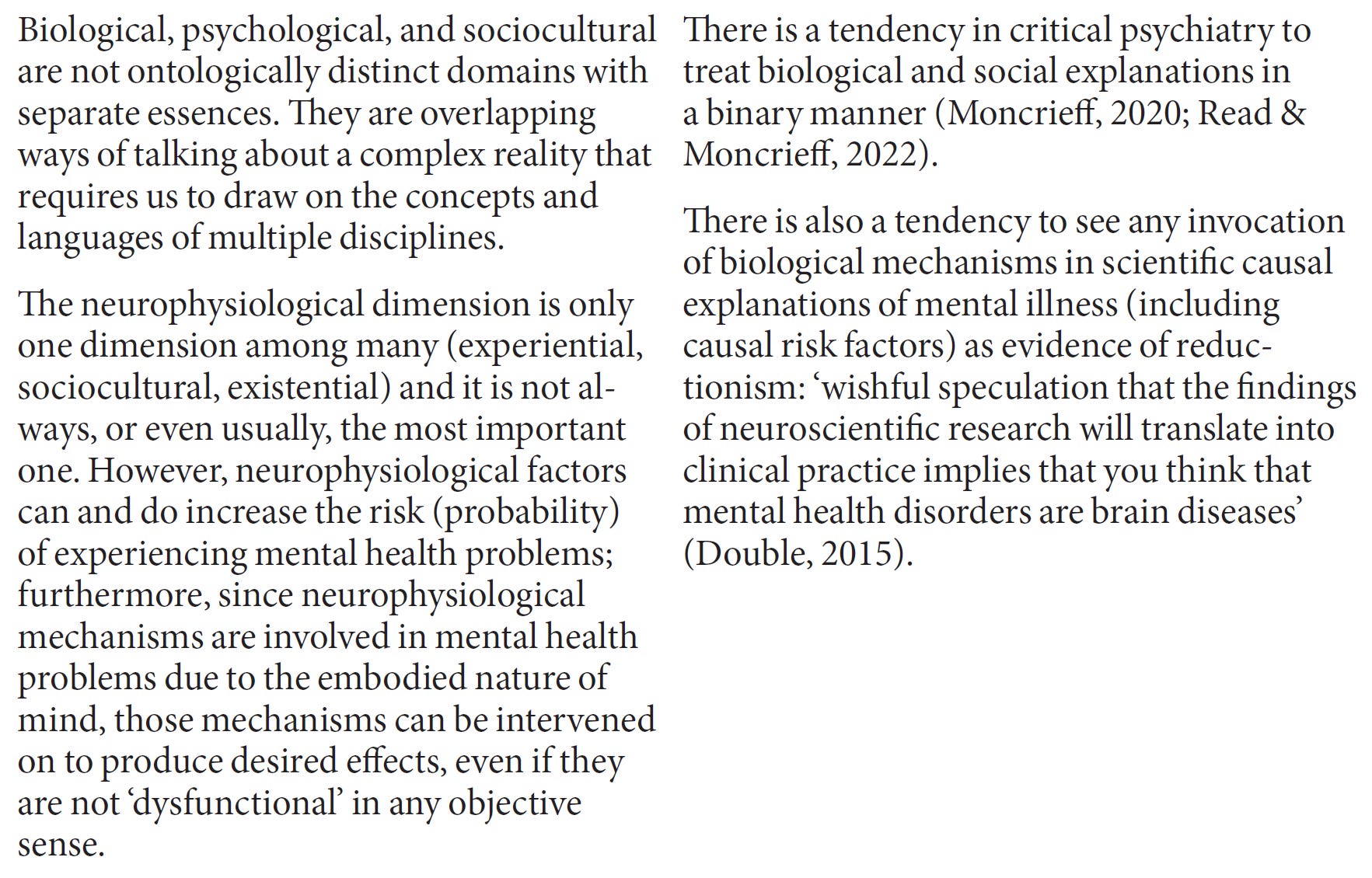


Some additional points that are relevant to various ongoing debates.
Agency and the disordered self. Mental health problems can involve genuine impairments of agency. They are often disruptions in a person’s capacity for self-direction and engagement with the world that are poorly understood as intelligible responses to circumstances, devoid of such disruptions. Agency is embodied and enactive, so it can be constrained by neurophysiological, psychological, and situational factors alike, and restoring or supporting it is a legitimate therapeutic aim, achievable via many routes. By contrast, critical discourse tends to locate the principal threat to agency in coercion and medicalization, which can underplay the way in which mental health difficulties can be experienced as alien to, or at war with, the self.
The epistemic authority of lived experience. First-person testimony of suffering, harm, and what helps is epistemically indispensable, but valuing experiential knowledge is not the same as treating it as incorrigible or sacred. A socially objective science has to integrate service-user testimonies and experiences into a pluralistic process of mutual criticism rather than treating any single standpoint as authoritative.
Evidential standards and selective skepticism. Claims about efficacy, withdrawal, and long-term outcomes are empirical questions whose answers can be genuinely uncertain and contested. Critical discourse shows a tendency toward asymmetric skepticism, demanding very high evidence for treatment benefits while accepting strong claims about iatrogenic harm on far thinner grounds, and toward treating industry influence as a reason to dismiss favorable findings wholesale rather than as one bias among others to be corrected for.
The project of classification. There are active, empirically productive programs in classification of psychopathology (e.g. HiTOP, network models, clinical staging, evolutionary and cybernetic frameworks) that take dimensionality, comorbidity, development, and the limits of categories seriously while still aiming at scientifically valid and useful description. Critical stance toward nosology is often largely destructive; it can be effective at exposing reification but doesn’t offer scientifically or clinically credible alternatives.
Reflexivity and the sociology of critique. The sociological lens critical psychiatry trains on mainstream psychiatry should be applied reflexively to itself. Any critical psychiatry worth its name must be self-critical. Critical psychiatry rarely turns the demand for reflexivity inward, tending to position itself as straightforwardly on the side of the marginalized in a way that obscures how its own positions are situated and interested.
Iatrogenic harm. Iatrogenic harm, including things like overdiagnosis, polypharmacy, dependence and withdrawal, are genuine issues of concern and need to be addressed. These are also issues that can be and ought to be addressed within the frame of competent and virtuous psychiatric practice, while acknowledging the reality of mental illness and the necessity of treatment for many. Critics of psychiatry often deploy iatrogenic harm as a delegitimating argument against diagnosis and pharmacotherapy as such. It is notable, for example, that the 2020 documentary film “Medicating Normal” about five subjects harmed by prescribed medications focused not only on drawing attention to iatrogenic harm but also insisted (including in its title) on making the argument that mental health challenges experienced by these people were instances of “normal” suffering that was needlessly medicated. It is not enough for there to be iatrogenic harm, psychopathology itself must be illusory.
Coercion and the values of care. Critics of psychiatry at times present their own value commitments (anti-coercion, autonomy-maximizing) as if neutral or self-evident, when they are in fact trade off against impairments and duties of care. Impairments in decisional capacity cannot be denied. We need to recognize the disability and disruption that accompanies mental illness; it is not a fiction, and systems of care are a necessity. However, we can and we should minimize involuntary care as much as possible by expanding options for voluntary care and by cultivating a social commitment to care that prioritizes human dignity.
In a note on substack, Sascha Altman DuBrul asked in the context of MAHA, “what do we do when our analysis gets picked up by people whose politics we find dangerous? How do we hold onto the legitimate critique without becoming useful to a project we oppose?”
I am inclined to see this in part through a Latourian conceptual lens. The thesis by Bruno Latour in 2004, that “a certain form of critical spirit has sent us down the wrong path, encouraging us to fight the wrong enemies and, worst of all, to be considered as friends by the wrong sort of allies,” is quite relevant to the debates about critical psychiatry and MAHA at hand, and I’ve played with that Latourian thesis here:

References (for the table):
Aftab, A., & Stein, D. J. (2022). Psychopharmacology and explanatory pluralism. JAMA Psychiatry, 79(6), 522–523.
Bracken, P., Thomas, P., Timimi, S., et al. (2012). Psychiatry beyond the current paradigm. British Journal of Psychiatry, 201(6), 430–434.
Double, D. (2015). Giving up the disease model. Lancet Psychiatry, 2(8), 682.
Double, D. B. (2019). Twenty years of the Critical Psychiatry Network. British Journal of Psychiatry, 214(2), 61–62.
Moncrieff, J. (2020). ‘ It was the brain tumor that done it!’: Szasz and Wittgenstein on the importance of distinguishing disease from behavior and implications for the nature of mental disorder. Philosophy, Psychiatry, & Psychology, 27(2), 169–181.
Read, J., & Moncrieff, J. (2022). Depression: why drugs and electricity are not the answer. Psychological Medicine, 52(8), 1401–1410.
Yeomans, D., Moncrieff, J., & Huws, R. (2015). Drug-centred psychopharmacology: a non-diagnostic framework for drug treatment. BJPsych Advances, 21(4), 229–236.
The guiding principles of the American Psychiatric Association include the following principle under the heading of Science As Our Foundation: “We ground every decision in evidence and clinical rigor to ensure patient-centered, high-quality care for all.”
I am rereading a book, Chance and Necessity (1970) by the late Jacques Monod who won the 1965 Nobel Prize in Physiology and Medicine. The preface of his book includes the following words by Monod: “Nowadays it is risky for a man of science to use the word ‘philosophy,’ even with the qualification ‘natural,’ in the title (or even subtitle) of a book: this is guaranteed to earn it a distrustful reception from other scientists, and from philosophers at best a condescending one. I have only one excuse, but I believe it is sound: the duty, today more imperative than ever, which is incumbent on scientists to consider their discipline within the larger framework of modern culture, with a view to enriching the latter not only with technically important findings, but also with what they may feel to be humanly significant ideas arising from their area of special concern.”
Of course there are areas of scientific and philosophical disagreement. But there are also areas of wide agreement that do not require unanimity. I wonder if members of the American Psychiatric Association (APA) have tried to agree on more specific scientific and cultural principles. It would be even better if that could be done in collaboration with members of other professional groups (e.g., psychologists, social workers, attorneys) with the best interests of patients in mind.
It's almost as if the 'critical camps' are unaware of the international (and primarily non-American) field called "philosophy of psychiatry", which now has well over 60 volumes filled to the brim with 'dissenters', many with their own rather interesting metaphysics that are anti-reductionist and some even anti-physicalist. Many of those volumes published decades ago are now integrated into mainstream cognitive science (e.g. the growing popularity of panpsychism). If the critical folk simply expanded their horizon away from pure constructivism (which is basically anti-foundationalist) then we wouldn't be watching these "back and forth" fights.
But when their starting point is "Objective truth is a social construct" (aka, anti-foundationalism) then any philosophical discussion becomes an automatic non-starter. Imagine your first premise being "Objective truth is a social construct" and then proceeding to making truth-claims about human suffering, DSM, oppression and such and such. Notice that the first premise automatically cancels out all other premises. Just like eliminativism, it is self-defeating from the start.