


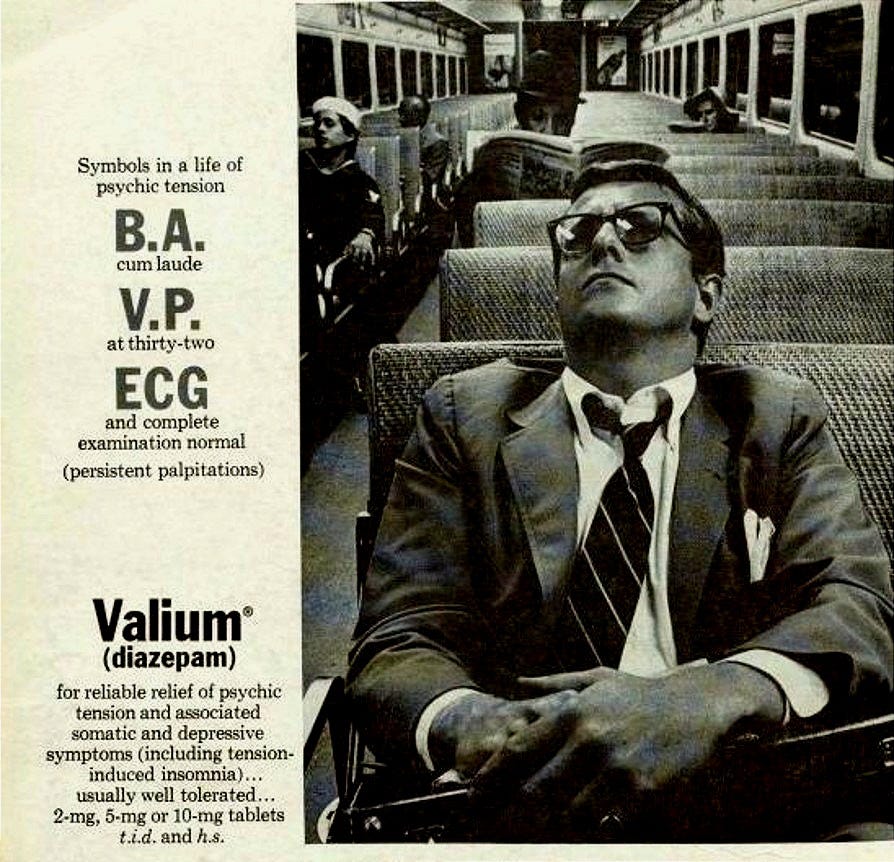
“I do not want to have these problems that are notoriously difficult to solve, about which there is no professional agreement. I do not want to embark on a years-long project dedicated to my own mind.” Lauren Oyler, My Anxiety
“I had 3 young kids and was a touch anxious. So I did what you do… asked a psychiatrist for some Zoloft.” Lindsay Clancy, from a note on her phone.
“I cannot stress this enough—if you are in distress, seek treatment. It works. But, and I can’t stress this enough either, the treatment of mental illness is at a primitive stage.” Paul Bloom, Psych: The Story of the Human Mind
Psychiatric treatment is often enough a frustrating affair, for the patient, for the clinician, for the caregivers, basically for everyone involved. At every step, we are plagued by uncertainties, unknowns, worries, risks, desperate requests for interventions, ambivalence about treatment, and a liability that sticks to providers like tar.
We have highly imperfect tools at our disposal, and more and more we rely on these tools in situations where their use is less-than-necessary. I am focusing mainly on psychiatric medications here, but psychotherapy is no less imperfect and sought after. Neurostimulation, imperfect as well. Psychedelics, don’t even get me started. Anyway, the point is, there is no refuge. Anyone selling you anything better than ‘highly imperfect’ in the realm of mental healthcare is a fool or a grifter. (And this includes deprescribing and tapering…)
I don’t know, man, I feel like the psychiatric profession messed up big in the tone it took when it came to public outreach and mental health awareness efforts. We communicated to people that we have stuff figured out, that we know what to do. Come to us with your problems and we will fix you! Unfortunately, we know jack shit…
We can look at the issue of seeking-help-from-medicine along a number of axes:
The extent to which addressing a problem requires specialized knowledge possessed by trained clinicians
The extent to which clinicians control access to effective interventions. This can be a consequence of specialized skills (e.g. performing surgery or specialized psychotherapies) or manufactured (e.g. access to medications restricted by prescription)
The magnitude of benefit that can be expected from the interventions and how reliable the benefit is.
The ways in which the interventions can cause problems or leave you worse off.
The stakes at play and the cost of delay or inaction.
Degree of disagreement around values and preferences.
Ecology of alternatives to clinical care. Where else can you go?
The degree to which a doctor’s judgment is preemptory vs contributory. At one end, it is strongly preemptive; it overrides or replaces your judgment. Whether a breast lump is benign or malignant, the doctor’s judgment takes precedence. At the other end, the doctor’s judgment is contributory. It is one input that exists alongside other considerations, and it is defeasible based on your assessment of the situation.
Norms of consultation, i.e., whether you are expected to bring a problem to doctors. At one end, it is prescribed, expected or established. You go to the doctor if you have a breast lump. At the other end, it is optional. If you are struggling with grief or marital conflict, you can go to a therapist, but you don’t have to. If you are binge eating, you can go to a therapist or a psychiatrist, but there isn’t a strong expectation that you have to.
When we start treating weak norms of consultation as strong norms, when we assign preemptive authority in areas where only contributory authority is justified, when we destroy traditional cultural means of support to shunt people into medical treatment, we erode people’s capacity to meet suffering with the resources they already have or could have had outside medicine. When we rely on interventions that are weak or unreliable and at times harmful in situations where their use is optional and based on unrealistic expectations, we set ourselves up for frustrations and complications. There are situations that are high stakes, that require specialized knowledge, where there is a scarcity of viable alternatives outside medicine, and where deference to experts makes sense, but these are (were?) also rather circumscribed and uncommon.
Thanks to public messaging colored by delulu optimism, many people showing up at the clinics have a misplaced confidence in our ability to scientifically characterize their problems or help them in a timely, efficient, low-hassle manner.
The real message to the public should’ve been something like: we are an immature science; our treatments are imperfect and flawed; they help some people some of the time, and we don’t quite know who will benefit or how much; they come with risks, at times serious risks, and no one can know in advance how they’ll affect you; when they work, no one can say how your relationship to them will change over time. If the resources of ordinary life, self-help, and support available to you through family and friends have failed you, then these imperfect tools are available for you, but don’t expect any miracles. There is so much suffering out there and we are just scratching the surface. If you seek help, you may find a collaborative doctor who is attuned to your concerns and sensitive to iatrogenesis, but don’t count on your luck.
In some ways, it is impressive that we have effective psychiatric medications at all. Imagine being transported to the early 20th century and what do you have in terms of psychiatric medications? Chloroform? Ether? Morphine? Bromides? Phenobarbital? Thank God for the modern pharmacopeia. Even the much-doubted and much-maligned SSRIs, when they work, they work beautifully. With the right patient, you can see mania and psychosis melt away with mood stabilizers and antipsychotics. It’s a joy to see patients get better with treatment. I scoff at the skepticism of willfully ignorant critics who think we have made no advances in mental health treatment over the past century.
But. But. It is absolutely true that these treatments leave a lot to be desired. The truth is that even wielding the power of placebo, there is only so much benefit to be gained and only so many people to be helped. Sooner or later, the specter of treatment resistance, inadequate response to treatment, treatment difficulties—whatever term you find acceptable—rears its head. And we haven’t even brought up treatment aversion, poor tolerability, and iatrogenic complications to the mix yet.
Could the medications cause weight gain, insomnia, sedation, agitation, suicidal thoughts, dependence, sexual dysfunction, tremors…? Possibly. A certain percentage of people do experience these problems. That could be you, yes, it is a chance. We can monitor closely, address any problems that may emerge, stop the medications in a timely way, etc. But no one can guarantee risk-free treatment. We can be transparent about the risks and be attentive to your concerns, and we can work collaboratively, but ultimately it is your decision whether these potential risks are acceptable to you. Their use requires transparency about uncertainties, mechanisms, trade-offs, and alternatives.
The imperfections of psychiatric medications, their ability to both help and harm, the attitudes of conviction as well as ambivalence toward their effects put prescribers (and patients) in a no-win situation. Damned if you do, damned if you don’t. If you don’t prescribe, you are not taking the person’s suffering seriously; you are not recognizing and honoring their requests for help. Prescribe and something bad happens, and you are now guilty of harming them with unnecessary treatments for their ordinary life problems which should never have been medicalized. Take their concerns about tolerability seriously, and discontinue and switch medications in a timely manner without expecting them to endure side effects, and you are now guilty of subjecting them to irresponsible experimentation and rapid switches that put them at risk of further destabilization. It’s Schrodinger’s pharmacology: the medication is simultaneously a medically necessary treatment for a disorder and a reckless intervention for a problem of living, and the wave function will collapse into one or the other once you open the box.
I am writing this out of a sense of exhaustion. Exhaustion at confronting the flood of human suffering with the flawed instruments. There is a tendency, in a situation like this, to deny or minimize this suffering. Overdiagnosis is the cry of our age. That is not my impulse. I recognize this suffering as legitimate, as deserving of a proper response. I wish we had the means to fully recarve our minds and bodies and readjust our operational settings, but we don’t. Maybe we’ll get there one day, but we are not there yet. Bearing witness to pain goes a long way, but it is not enough.
Patients come to us with deep wells of misery whose depths have not yet been plumbed, and they want the perfect drug, as benign as a multivitamin, as effective as fentanyl. A drug that will silence the alarms blaring in the ruins of their bruised lives. A drug that will restore the will to live in their lonely, adrift existence. There has to be a drug out there, right? Zoloft, Xanax, Adderall, Ketamine… this can’t be as good as it gets, right?
I find it so frustrating that people cannot keep more than 1 idea in their head at the same time. It's obvious from data, clinical experience and anecdote that the same drug can be a poison, a panacea or a placebo, depending on who takes it and in what circumstances. People are hugely varied, brains are hugely varied, societies are hugely varied: why would everyone be affected by a drug in the same way, leaving out for a minute facts like tolerance and dosages. If we just understood this, we would stop having the hype cycles of "prozac makes you better than well" "prozac makes you suicidal" and "prozac is placebo." It can be any of those depending on as the psychedelic folks say, set and setting.
Thank you for your honesty - and have a break!