


David Mintz, MD, is a psychiatrist and currently serves as Director of Psychiatric Education and Associate Director of Training at the Austen Riggs Center in Stockbridge, Massachusetts. Mintz and colleagues developed a psychodynamically-informed approach to effective prescribing, rooted in the evidence base regarding psychosocial aspects of medications. At Austen Riggs, he is involved in the treatment of complex and multiply comorbid patients who have typically not responded to first- and second-line treatments, including extensive pharmacotherapeutic trials. He has published and presented widely on this topic, including the 2022 book Psychodynamic Psychopharmacology: Caring for the Treatment-Resistant Patient, published by APA Publishing. He is the recipient of the Massachusetts Psychiatric Society 2024 Outstanding Psychiatrist Award for Education.
Awais Aftab, MD, is a clinical associate professor of psychiatry at Case Western Reserve University School of Medicine. He is interested in conceptual and philosophical issues in psychiatry. His first book, Conversations in Critical Psychiatry (OUP, 2024), is an edited collection of interviews.
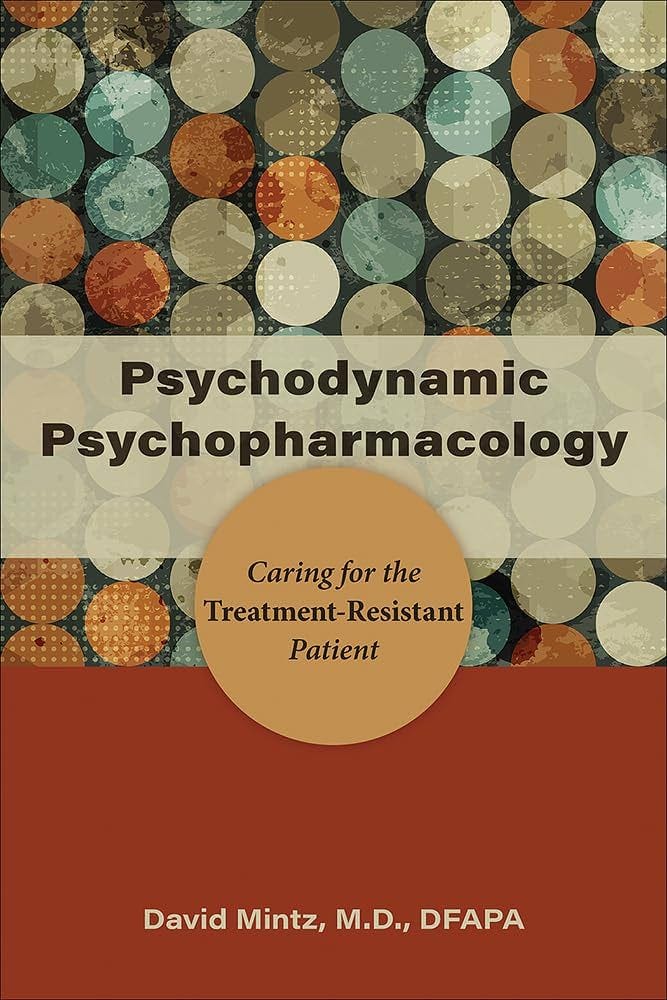
David Mintz is a master of applying psychodynamic thinking to the practice of psychopharmacology. He does it with unparalleled elegance and sophistication. I can chart the evolution of my own thinking of psychopharmacology in terms of Before Mintz and After Mintz! His core message is that the effects of psychiatric medications are produced, in part, through people and relationships and the meanings patients attach to illness and pills. Psychodynamic psychopharmacology builds on six principles: avoid mind–body splits, know who the patient is, work with ambivalence, cultivate the alliance, watch for countertherapeutic uses of meds, and use countertransference wisely. Mintz reframes “treatment resistance” in two ways: resistance to medication (nonadherence, nocebo-driven side effects) and resistance from medication (when drugs or their meanings quietly maintain problems resulting in chronification). Because many patients receive care from multiple clinicians, Mintz insists on integration of pharmacological and psychotherapeutic treatment; split vs. combined care vis-à-vis psychiatrist vs. psychotherapist is less important than whether everyone shares a coherent, person-centered treatment conceptualization aimed at restoring agency and functioning.
Aftab: “Treatment-resistant” features prominently in the subtitle of your book and in the contents as well. Given that psychodynamic aspects are observable across the full range of psychopharmacology, I personally find the framing unnecessarily limiting. It also sends an inadvertent message: one need not be concerned with the meanings attached to medication until we run into treatment resistance. Another consideration is that “treatment resistance” as a concept has itself come under scrutiny and many in the field are moving away from it, and it would be unfortunate in my view if psychodynamic psychopharmacology gets linked too strongly to a concept that may very well become outdated. What are your thoughts on all this?
Mintz: That is an astute question, and, on one level, I agree that there are problems with that kind of framing around the question of “treatment resistance.” I think you are right, that a psychodynamically-informed, patient-centered approach, rooted in evidence, is likely to be helpful for any patient whether they are treatment naïve, or “treatment-resistant.” At the same time, I make a distinction between what is helpful and what is necessary. Not every patient needs the prescribing clinician to aim for a deeper understanding in order to create a treatment that the patient can make use of, but I think it is largely true of our patients who do not respond to treatment-as-usual. In other words, understanding who the patient is may be helpful for most patients, but it is often necessary for those patients whom we might describe as “treatment resistant.”
A couple of agendas, I think, led me to retain that language. When I started developing these ideas at the turn of the millennium, I was dialoguing with a psychiatric world in the grips of a kind of pharmacomania, and a psychodynamic perspective was almost stigmatized. Our deepening commitment in psychiatry to evidence-based practice meant, however, that the evidence was starting to tell us how many of our patients were not having satisfactory responses to pharmacotherapy, and I thought that the problem of treatment-resistance might be the way to get psychiatrists to grasp the tragic effects of biomedical reductionism.
Twenty years later, I also grappled with naming my book, both in the main title and subtitle. “Psychodynamic” was still kind of a bad word in psychiatry, and I was cautioned against using it by some mentors. I was also aware that the concept of “treatment resistance” had, as you noted, come under fire. In the end, I committed to keeping “psychodynamic” in the hopes of rehabilitating the term and showing the relevance of psychodynamics to contemporary psychiatry. Similarly, I retained the language of resistance because of how it joined the biomedical concept with historical meanings from psychoanalysis.
Aftab: One concern that has been raised by patients in the context of talk of “treatment resistance” is that they feel blamed by the provider for the inefficacy of the treatments. Psychodynamic psychopharmacology makes this “blame” concrete in a sense—not in a disparaging manner—and suggests, for example, that the patient may not be getting better because they are ambivalent about illness or treatment, or because the meanings attached to the medications or the clinical relationship have been turned to serve counter-therapeutic ends. You also discuss how “secondary gain,” the unconscious benefit that a person may derive from continued illness, may interfere with treatment. I want to acknowledge that all these phenomena are clinically real. I have observed them as a clinician myself in one form or another. My question however is: how do we respond to someone who fears that all this talk of meaning and ambivalence and secondary gain will ultimately end up creating clinical situations where patients feel blamed for their own lack of improvement (somewhat similar to how diagnoses of personality disorder are used by some clinicians in a patient-blaming, disparaging manner)?
Mintz: I’m glad that you asked, because it gets at a predictable misunderstanding, as resistance holds a particular psychodynamic meaning. Resistance is a ubiquitous feature of mental life. It is intended as a self-protection, but, when left to the unconscious, also has the potential to undermine development or agency. Just like I hoped to help rehabilitate the term “psychodynamic,” my intent was similar for the concept of treatment resistance… essentially, I hoped to rescue it from blame. To help the patient with their resistance requires almost the exact opposite of blame. We need to understand, first, how dynamics driving treatment resistance, whatever form they take, make total sense in the context of the patient’s history. Now there is subtlety in this, because, while we do not blame, we do strive to help the patient to discover their agency in relation to the resistance. The intent of the model of Psychodynamic Psychopharmacology is to challenge a reductionist model that puts too much power in the medications and too little in the patient… power we aim to help extend in making unconscious motivations conscious.
Let’s think about the ambivalence that you named. The patient is not to blame for something so ubiquitous, and even reasonable. I, for example, don’t really want to take medications and, I suspect, neither do you. The idea is that, by highlighting the role played by the patient’s ambivalence, as expressed perhaps in forgetting to take medications, the unconscious becomes conscious, empowering the patient to take steps to counter the effects of the ambivalence… or steps to find a different treatment if their ambivalence really leans more heavily against than for.
Rather than blaming, the effort is to understand that the patient has good reasons, even if they are sometimes in the distant past, for any resistance that they mount, unconscious or not. They may have learned deeply, for example, that caregivers are likely to be more dangerous than helpful… and it is our job, first, to respect their reasons for wanting to protect themselves from us before trying to work through the ambivalence.
If you read the book, you will see that the term resistance carries another set of meanings of resistance as “the resistance,” that is to say, a kind of fight against tyranny. As I try to emphasize throughout my book, dehumanizing aspects of our system are also a major source of treatment resistance. When we approach patients in ways that are objectifying, dehumanizing, or disempowering, it is no surprise that they would, consciously or unconsciously, resist what we are doing. Further, if we treat patients as neurobiological substrates for our medications, neglecting all of the complex and conflicting aspects of their subjectivity, we can collude with their resistance or abandon them to it. Paradoxically, if we blame our patients, that would be the precise moment that, if anything, we are to blame.
Aftab: I remember when I first came across your description of “chronificaton” and my jaw almost dropped because it is such a common dynamic in psychiatric practice and yet I had not seen it described before with this clarity. In your Carlat Psychiatry Report interview, you said,
“I think this is one of the most underappreciated challenges facing psychiatrists. Imagine a patient who wants more medications. Every time you add one, they say it’s helpful, but you find yourself wanting to put on the brakes. Something just feels icky. What happens is that the patient is becoming progressively deskilled because emotionally, they are now increasingly relying on medications rather than more mature coping strategies. And so, to the extent that you keep prescribing without doing anything else, you are participating in that patient becoming a chronic patient… One sign of this is that the symptoms are getting better, but the patient is not getting better. They are not more functional.”
In my own practice I have noticed that, one, it takes a lot of mindfulness on my part not to contribute to this process (the default clinical mindset of “shut up and treat” is a fertile breeding ground for chronification), and two, it is rarely enough for me to explain my concerns to the patient to break the cycle of chronification. Their psychological need to rely on medications at the expense of emotional skills isn’t thwarted simply by making the dynamic explicit, more work has to be done. Another interesting thing I’ve noticed about many such patients is that they often have been in weekly psychotherapy for many years, such that on paper they are “doing the work,” but when I look into what’s happening in psychotherapy, usually the psychotherapy process seems stuck to me (as an outside observer) and the therapist seems to have been co-opted into the process of chronification. Have you observed that too?
Mintz: On your first point, you are discussing what I call “treatment-resistance from medication,” where the medication, or some meaning ascribed to it, interferes with the patient’s agency and adaptability, typically in a way that serves some important defensive function for the patient. And I do think this is both one of the most vexing and under-explored issues that we face, and a source of real suffering for us as clinicians. And you are correct that it is not simply a matter of showing the patient that something about their use of medications is leading them into chronic patienthood. With patients in this situation, we are often playing the long game, working, over time, to highlight counter-therapeutic dynamics and to foster agency, using the alliance as a fulcrum. While there are benefits to the use of symptom scales, they can pull us towards a symptom or illness focus and away from a developmental focus, where our effort is aimed primarily towards not just improving function, but prescribing in a way that explicitly aims to help the patient achieve their developmental goals. A pharmacotherapeutic focus on development, and not just a decrease of symptoms or suffering, can often strengthen the alliance, as you are experienced as supporting the patient’s human striving. Furthermore, a focus on the patient’s developmental goals makes it clearer, to you and your patient, when medications help symptoms, but also stall development.
As you suggest, psychiatrists are not the only ones who unwittingly collude with such chronifying dynamics. There is a lot of bad therapy out there that, similarly, focuses on helping the patient feel better, but not get better. There can be a pull, especially with patients who rely on splitting to manage intolerable feelings of badness. Blame can be shifted onto the illness or toxic people in the patient’s life in a way that relieves the patient of the burdens of responsibility and guilt, but undermines agency, with no way to manage their suffering except an endless cycle of projection.
Aftab: What are some defensive functions that new prescriptions can serve for the psychiatric provider? How can treatment take on a “sadistic” quality?
Mintz: Your question makes me think of one of my favorite papers, The Ailment (1957) by Tom Main, where he notes that
“the sufferer who frustrates a ·keen therapist by failing to improve is always in danger of meeting primitive human behavior disguised as treatment.”
The close encounter with human suffering that we clinicians face is not easy, and we are often at risk of being overwhelmed by what it stirs in us. Through projective processes, the patient’s helplessness becomes our helplessness, their rage becomes our rage, and if we cannot recognize these intolerable feelings in us as communications of the patient’s own suffering, we become prone to acting to rid ourselves of those feelings. The prescription pad comes out as a means, primarily, of ridding ourselves of helplessness, for example. When we experience the patient’s urgent need as a reproach… and it may actually be a disguised and vengeful reproach aimed at failed caregivers from the patient’s past… medications can be added on top of medications, and in the end, it becomes less treatment than an effort to stifle the communication that fills us with the patient’s bad feelings.
Maybe less potentially harmful are the situations where the therapist-prescriber unconsciously uses medication discussions to manage their feelings. For example, I consulted to a Psychotherapy Case Conference in one residency, where psychotherapy was videotaped for supervision. Very quickly, the patient began expressing her despair. The novice therapist, at least as I saw it, got overwhelmed by the intensity of the patient’s suffering, and rather than encouraging the patient to explore further, shifted registers and asked: “so, have you been taking your antidepressant?” This seemed to represent a defensive shift on the part of the resident to move to a less distressing discussion in which the resident felt some mastery… even though it risked confirming the patient’s unconscious fear, that something in her was intolerable.
This is all hard enough for individual clinicians, but I think it is kind of a crisis in many of our psychiatric institutions. In the old days, before capitalism really got ahold of healthcare, there was an awareness of how the patient’s inner world could be projected into the outer world, and of the need for reflective spaces to process dynamics unleashed into the milieu. Unfortunately, in the current environment, if there is space for reflection, it is experienced by the corporate elements of the system as an inefficiency that does not generate any money, and workload is increased until there are no reflective spaces. Recently, I had lunch with some psychiatric residents at a reputable program where I had just given Grand Rounds, and this was the issue on their minds. The nurses, whom I presume felt harried, unsupported, and probably angry, often demanded intramuscular medications for patients who had acted out, but there was concern among the residents that this was more about control than it was a helpful effort to provide containment for the patient. If anything, if the residents ordered those medications, it felt like it was to medicate the nurses’ distress. Unfortunately, there were no spaces in the life of the unit for such concerns to be aired and worked through.
Aftab: What are your thoughts on the role of meaning in iatrogenic harm? There is a burgeoning prescribed harm movement, especially online, and while iatrogenic harm is a clinical reality, it also seems to me that there are prominent psychological forces at play in situations where people have built identities around being harmed patients or psychiatric survivors. I am curious if you have any observations in this regard.
Mintz: Honestly, for most of our medications, the placebo effect contributes at least as much to the effect of the medication as the putative “active ingredient.” And these effects are real, triggering real biological responses in the patient. So many of our patients, however, expect more harm than help, and so, instead of placebo responses, they experience nocebo responses, where expectations of harm are transformed into side-effects. It is clear that nocebo responsiveness can be exacerbated by social media, so there is a paradox in this. Those platforms, intended to empower patients, also increase the likelihood that patients will be harmed in encounters with psychiatric systems, mediated through meaning.
But that’s just one of many sources of meaning-based iatrogenic harm. Another one worth mentioning is when clinicians offer a reductively biologized explanation of the patient’s suffering, neglecting the complex interplay of biological, psychological, and social factors in psychiatric illness. Research suggests this fosters a kind of helplessness in patients that worsens prognosis, a feeling that biology is destiny.
But, even without the help of clinicians, patients can get attached, defensively, to reductionist explanations of their struggles, often, as I said before, in ways that can relieve them of responsibility and related feelings of guilt or shame, but also which restrict their experience of personal agency. In recent years, we are increasingly seeing patients whose identities are mediated by diagnostic categories. This is a complicated phenomenon. On the one hand, I have certainly encountered patients who have truly been crippled by an illness identity that comes to mean “I can’t” and “I shouldn’t have to,” rather than “this is more challenging for me than the average person.” On the other hand, these illness identities, fostered online, can also become a source of community, and a kind of power that may support the patient’s development… or may not. The research is mixed on the benefits and harms of such illness identities.
There is, of course, also real harm that is directly mediated by the biomedical mechanisms of our medications. The thing is, given the true potency of meaning to bring about harmful physical manifestations, it is daunting or impossible for the doctor… or the patient… to truly know what the exact mechanism of harm is. Ideally, this is something that the doctor and patient would struggle together to try to understand. There are times when a patient “knows” exactly how medications harmed them. Paradoxically, I think, this usually points to some unconscious defensive activity, because these mind-body interactions are so complex that a true understanding will elude both doctor and patient.
Aftab: You dedicated the book, among other folks, to the memory of Leston Havens. I have heard from so many people about the profound influence he had on them, especially as a psychiatric teacher. What made Leston Havens so special? Is there a book by him that you would particularly recommend?
Mintz: Les’s books are great, but, for me, they don’t quite capture his genius at connecting with people in real trouble, and with his iconoclastic spirit. When I interviewed at Cambridge for residency, I got to see him interview a patient on the inpatient unit. He started the interview, after a Les-like awkward silence, by saying to the patient: “You know, given how fucked up we all are, it’s amazing we ever help anybody.” The honesty blew my mind. That day, I cancelled all of my other interviews because I knew that I would do what I had to to train with him. And he certainly did not disappoint. Let me tell you what advice he gave to me and my class on our first day of residency. The first bit of advice was: “Don’t read… but, if you have to read, read a novel.” What he was conveying was that our patients were our texts. We should learn from them how to be effective psychiatrists, rather than apply our book learning to them. His second, related, bit of advice was: “learn to lie to your supervisors, because, if you tell them what you’re doing, they’re not going to let you do it.” While partly tongue-in-cheek, Les was highlighting that making a connection with our patients, many so hurt, disappointed, or paranoid that they were hard to connect with, was our priority. He was truly unique as a teacher. To get back to your initial question, I guess that the book that was most impactful for me was A Safe Place, though the one that probably had the biggest overall impact on psychiatry was Approaches to the Mind.
Aftab: I’d like you to say something about what makes the Austen Riggs Center so special and distinctive. It is an exceptional place providing exceptional treatment, in many ways the last bastion of inpatient psychoanalytic treatment in America. The current medical, economic, and regulatory climate in the US is entirely hostile to the Austen Riggs model of practice. There seems to be clearly a resurgence of interest in psychodynamic thinking among clinicians, including psychodynamic psychopharmacology among psychiatrists, and that’s great, but do you see any signs that more places like Austen Riggs will emerge in coming years?
Mintz: I sometimes joke that Austen Riggs is so far behind that we’re ahead. As you note, we are a last-of-our-kind psychoanalytic treatment center. There are few, if any, treatment centers that offer such intensive and potentially long-term treatment focused on helping patients to understand themselves better, and thereby, in making conscious things that were unconscious, to extend their agency over themselves and a freedom of choice less encumbered by unconscious pressures. More than that, I think that we also are committed to an idea of patient authority that is increasingly under threat in a world that thinks that serious psychopathology requires treatment in settings where the patient is protected from themselves and separated from the world. Though there are other open settings, I am unaware of any settings as open as ours… where such complex patients are afforded such freedoms. Except for asking our patients to sleep in our buildings in their first six weeks of treatment, there are no real restrictions on the freedoms of our patients. We see this freedom as necessary, as we aim not just to keep our patients safe, but to help them learn to stay safe. Of course, this does not mean that anything goes. We try to hold our patients accountable for responsibly using this freedom, and we mobilize the strengths of the therapeutic community to address most symptomatic behavior, which typically affects not just the patient but also the community.
The fate of Riggs and places like Riggs is a complicated question, and I have both a pessimistic answer and an optimistic answer, both of which feel true for me. On the one hand, I don’t think there is a will, in the US, to support definitive, long-term treatment. Even though there is some evidence from European studies that, when you give complex, high utilizing patients a 2-year, 4-times-weekly psychoanalysis, it only takes the system 3 years to recoup those resources from lower healthcare costs, our patchwork system of payors leaves little motivation to invest in patients’ future well-being. UnitedHealth, for example, doesn’t want to pay for a 2-year analysis when Cigna, a few years down the road, will be the one who reaps the rewards, and vice versa.
On the other hand, the evidence is moving us to a recognition that mainstream treatment fails far too many of our patients, and that many need a more comprehensive approach. In response, there is currently a proliferation of medium-length skills-based residential programs in the industry. I think we will find that these programs, which focus on coping skills, will also not meet the needs of many patients. I suspect, and hope, that psychodynamic treatment, which was late to the game of building an evidence base, will be moving back into the mainstream in the coming decade. I am hopeful, too, that, in our current era where productivity pressures make people feel increasingly like cogs in a big machine, psychoanalytic treatments focused, like at Riggs, on growth, thriving, personal authority, and the importance of social connections, as opposed to just “coping,” will, sooner or later, strike the right chord.
Aftab: To what extent were psychiatrists practicing in the late 1980s, early 1990s aware of psychodynamic considerations around psychopharmacology? Someone like Peter Kramer—Listening to Prozac (1993)—was very attuned to the meaning around medications, but he may have been an exception, I don’t know. To what extent is psychodynamic psychopharmacology a lost art, a skill that was perfected in the past but has fallen into disuse, and to what extent psychodynamic psychopharmacology is a theoretical and clinical development of the 21st century? Your book is full of contemporary references and it does seem to me that our understanding and knowledge of psychodynamic considerations around pharmacology is much more sophisticated than what it was in the early 1990s.
Mintz: As the pendulum swung from a psychoanalytic to a biomedical framework, there was a period of time where the role of meaning in medication response was of real interest in psychiatry. The research on set and setting with psychedelics and the emergence of the biopsychosocial model are cases in point. Kramer was at the tail end of this, as, by the 1990s, psychiatric research on psychosocial aspects of pharmacotherapy had largely disappeared. Interestingly, primary care took up the mantle of being the field that treated the whole person, and carried that research tradition while psychiatry largely forgot about the meaning of medication in the midst of our pharmacomania. Psychology also continued to research questions of meaning and medication, but that research took on an anti-psychiatry tone, so went largely ignored by organized psychiatry. The focus on evidence-based practice in psychiatry, I think, led us to see more clearly the significant limitations of our current medications, and this, as the pendulum swings back in psychiatry, is driving a renewed interest in ways that attention to psychosocial aspects of the prescribing process can optimize—or undermine—outcomes. I know there is a lot of interest in my book, especially among younger psychiatrists. I have a hope that my book, which I think of not as antipsychiatry, but as antireductionist, is contributing to the shift that you describe towards greater sophistication, and that the emerging generation of psychiatrists will be committed to a much more biopsychosocial psychiatry that recognizes the role of early adversity, systemic injustices, power relations, and psychodynamic factors shaping patients’ ability to make healthy use of treatment..
Aftab:
“Medications exert their effects via multiple pathways. Some are mediated biologically via their actions at various receptor sites, whereas others are mediated symbolically through the meanings they have for patients and the doctor-patient relationship,”
you say at the beginning of the book. I had started thinking along those lines before I even knew what psychodynamic psychopharmacology was (and I confess, I was unfortunately rather late in coming across your work). It is clear to me that many medication effects are describable in psychological and cognitive terms that reside outside of “psychodynamic thinking” as conventionally understood. We see this, for example, in efforts to understand medication effects using computational, phenomenological, and enactive concepts. The resurgence of scientific interest in psychedelics and the role of the psychedelic experience in psychological improvement is an area where some really interesting work is going on. Are you also excited about these non-psychodynamic explorations of the multiple pathways through which medications exert their effects?
Mintz: Yes. I do find these developments exciting. Erik Erikson noted that what he had to offer was not a new thing, but a new way of looking at things. My inclination, when you describe these developments, is that, in many cases, they are, in part, different language for the things that I am trying to draw attention to. While, at this moment in history, I have felt it is important to frame things through a psychodynamic lens, right when it felt that psychiatry was ready to throw away a wealth of psychoanalytic wisdom because of the flaws in or limitations of the model, I am delighted for any pluralistic model or development that moves us away from a reductionist form of practice, and recognizes how truly complex is the interaction between biological and psychological aspects of our treatments. And I do think that, often, these new concepts are reformulations of older ideas, though, I admit, I probably haven’t thought about it with the sophistication that you have. I mean, a few years ago, I saw a presentation of yours that explored the concept of embodied enactivism and, at least in one aspect of your presentation, I thought that you were precisely describing how transferences develop, continue to shape a person’s life despite evidence that the rest of the world is not typically like one’s primary caregiving figures, and then, through a psychoanalytic approach that focuses on how those past early experiences become a filter for present experience, can be modified so that patients are more adaptable to the realities of the here-and-now.
Similarly, psychedelic research, I think, is raising important questions that challenge dualistic assumptions. For example, and with the caveat that I am no expert on the topic, some of the research suggests that, for psychedelic medicine to really address treatment-refractory depression, a mystical experience is needed… which raises the question of whether it is the drug or the mystical experience that is healing, whether through the collapse of ego defenses or the experience of being at one with something larger than oneself. Similarly, a recent study of ketamine found that it does not seem to work if patients are not conscious when the drug is producing the dissociative effects, so is it the drug or the mental experience that produces the beneficial effects? So, yes, I am excited for any developments that encourage a pluralistic or non-reductive psychiatric practice.
Aftab: There is a lot happening in clinical trials at the level of meaning around treatments. Unfortunately, most of it gets swept under the umbrella concept of “placebo” and it ends up providing little illumination. How can clinical researchers do a better job understanding what is happening at the level of meaning in clinical trials?
Mintz: This question makes me think of the landmark TDCRP study, looking at which treatments were best for depression… pharmacological, psychodynamic, or cognitive-behavioral. While they, unsurprisingly, came to the Dodo’s verdict, all have won and all must have prizes, one of the interesting things about this study was that they collected a lot of other data, such as the quality of the treatment alliance. This allowed later researchers, conducting a secondary analysis of the data, to discover that the doctor-patient alliance played a larger role in antidepressant outcome than the so-called “active ingredient” of the drug. Industry-funded research is probably never going to do research to determine how to boost placebogenic factors. Their interest, for the sake of demonstrating the effectiveness of their drug is, in fact, precisely the opposite. Their interest is in minimizing placebo responses as much as possible, so the drug has a chance to separate from placebo.
In this context, the question is how do we incentivize research through funding mechanisms or scientific standards to explore this integrative dimension? The Affordable Care Act did try to incentivize patient-centered outcomes research, though that does not necessarily intersect well with the research on pharmacotherapy outcomes. There is probably a lot of simple data in pharmacology trials that could be collected. Incorporating simple measures of expectancy, therapeutic alliance, readiness to change, adherence, and prescriber communication into pharmacotherapy studies could be beneficial in so many ways. Emerging digital technologies that allow for ecological momentary assessment and passive sensing are primed for illuminating the ways that psychosocial variables impact pharmacotherapeutic response. At a larger level, hybrid designs that look not just at medication effectiveness, but also implementation strategies, mediating mechanisms, etc. would probably yield more information per dollar, while also examining variables that better reflect real-world practices rather than the rarefied environments of our typical pharmacotherapy trials.
Aftab: As you just mentioned, there is some evidence from clinical trials to suggest that the most effective group of prescribers achieves better outcomes with placebos than the least effective group of prescribers achieves with antidepressants. This makes me wonder if efforts to increase prescriptions of antidepressants at a mass scale via primary care physicians have fundamentally misunderstood the important ingredients of effective treatment. It is perhaps no surprise that simply prescribing antidepressants without attending to the therapeutic relationship leads to outcomes that fall well short of what we see under ideal conditions. What could have been done differently, in your opinion?
Mintz: I do think we have overestimated the impact of what we prescribe and fundamentally misunderstood the importance of how we prescribe to achieve optimal outcomes. I don’t think that primary care is necessarily the weak link, though. As I said, during the 20 years or so of psychiatric pharmacomania, primary care was carrying the torch of meaning in pharmacotherapy. The fault, I think, lies in the system of care that has profoundly disrupted the capacity for doctors to have ongoing and meaningful relationships with their patients… in so many ways, when our corporate overlords trim the fat from the system, for them, the fat is the relationship. My suspicion is that initiatives to better diagnose and treat depression would have had a much greater public health impact if primary care still looked like it did before managed care and corporate medicine got its hands on it.
Mostly, what I think we can and should do differently is promote and practice evidence-based psychiatry. By that, I mean not the evidence-based psychiatry that is focused merely on the responses to medications for narrowly defined DSM diagnoses, but also the evidence base that shows us that how we prescribe is as potent as what we prescribe. If we are truly committed, as we claim to be, to evidence-based practice, that evidence will arm us psychiatrists to push back on a system which, in many ways seems almost systematically to undermine the most potent aspects of care, the relationship. And here is a maybe provocative thought: if, as the evidence suggests, 50-75 percent of medication response is shaped by psychosocial factors, should our focus be commensurate with that impact? In residency, should half of our psychopharmacology instruction focus on how to form effective and empowering relationships with patients? Should half of our research and half of the articles in our journals explore the psychosocial dimension of care?
I would add that this is almost an existential issue for us. To the extent that we collude with capital-driven efforts to reduce us to mere prescribers and ignore the crucial importance of the uniquely human elements of the healing relationship, and that we buy into a diagnosis and algorithm-driven approach that neglects the patient’s subjectivity, it will not be long until we are mostly replaced by prescribing AI bots that are much cheaper for the system.
Aftab: Thank you, David!
For additional exploration of psychodynamic psychopharmacology in other interviews with David Mintz, see interviews with the Carlat Psychiatry Report and the Psychiatry & Psychotherapy Podcast with David Puder, MD.
This Q&A is part of a series featuring interviews and discussions intended to foster a re-examination of philosophical and scientific debates in the psy-sciences. See prior interviews here.
If you are a regular reader of this newsletter, and it deepens your intellectual life, consider a paid subscription to support this effort.
I had the same experience with my Les Havens interview: he beckoned me in with such warmth and then said, "so...what do you WANT?" He pulled you in and put you off your guard in the same breath.
He told us to fire our supervisors, and I also saw him interview a patient, with his "counter-paranoid position." Using his office to see patients (he told us not to borrow his books, but keep them) was like channeling some higher power.
The most memorable thing he said to me, among many memorable things, was when I asked what to do in therapy when I didn't know what to say.
"Wait."
I think it's really tough for psychiatrists who were not trained and grounded in psychodynamic concepts to add them on later in a way that doesn't feel awkward or forced, even with the best of intentions. The stated or implied ideas that there either really isn't time for that kind of conversation, or that the 'payoff' is not there, leads to more problems are subtle forms of bad treatment. I am so grateful that I was trained at a time (late 70's) when integration of meds with therapy (or just the MD-patient relationship) was developing.
The import of the meaning of meds ( and everything else) is truly at the center of this topic, and I can recall reading or hearing from Havens, Arieti, Yalom, Searles, Frankl, and many others who drilled into me that this matters so much.
Also, the idea that resistance is not only normal, but to be expected by both prescriber and pill-taker is one I've gotten a lot of mileage from. Telling patients that they should PLAN to have mixed feelings about the pills ( and me and therapy) normalizes it and cuts down on guilt or shame. it's gratifying to hear a patient being 'resistant' and then my saying, "good, of course, let's talk" - and it makes the process curiously fun.
I think the psychiatry profession has little awareness of how such things feed into the anger and vitriol of the anti psychiatry voices. The intensity of their feelings should not keep us from hearing their messages and looking in the mirror. It'd be wrong to dismiss those voices as being...resistant