


“Mixed Bag” is a series where I ask a guest to select 5 items to explore a particular topic: a book, a concept, a person, an article, and a surprise item (at the expert’s discretion). For each item, they have to explain why they selected it and what it signifies. — Awais Aftab
Darby Saxbe, PhD is a professor of psychology and neuroscience at the University of Southern California. She runs the Neuroendocrinology of Social Ties lab at USC, which studies the neurobiological adaptations that accompany the human transition to parenthood. She is the author of the new book Dad Brain: The New Science of Fatherhood and How it Shapes Men’s Lives (Flatiron Books, June 9, 2026). You can learn more about her here and find her on Substack, Instagram, LinkedIn, X, and Bluesky.
Book: Dad Brain
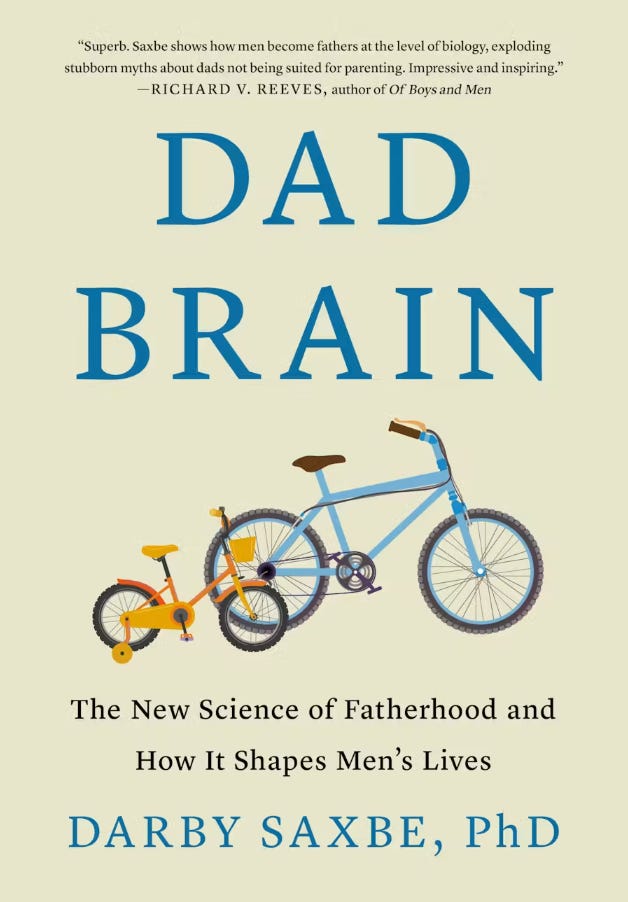
I’ll get the self-promotional part out of the way first and tell you about my new book, Dad Brain, which is about the science of fatherhood and how it changes men’s neurobiology, health, relationships, and identity. I drew on research I’ve conducted in my lab over the last fifteen years, following first-time parents from pregnancy across the first year postpartum. But it’s not just about my work; it’s about the evolutionary biology of fatherhood and about how men’s fathering roles have changed in contemporary societies and the implications for workplaces and societies. I interviewed dozens of fathers who shared their stories in the book.
As someone who was trained as an academic and has written mostly scientific journal articles, writing a popular science book was really fun. It felt like a sneaky vacation from my “day job”: I get to tell stories and even joke around a little? I’m proud of the book, and antsy and eager to get it out into the world. In the rest of this Mixed Bag, I’ll share some of the concepts, people, and articles that had the biggest influences on me while I was writing it.
Concept: Facultative adaptation
One of the most fascinating aspects of fatherhood is its variability. Some men are hands-on primary caregivers of children, whereas other men have absolutely nothing to do with their own offspring. Fatherhood is shaped in part by our biology—that’s a major theme of my book—but it’s also shaped by our culture and by the demands of our local social worlds. Why would we evolve to have such a wide range of behaviors from a genetically related parent? I find the concept of facultative adaptation to be a useful way to think about fatherhood.
In evolutionary biology and psychology, adaptations can be either obligate or facultative. An obligate adaptation could be called “hardwired”: it develops the same way regardless of environmental conditions. A facultative adaptation, by contrast, depends on the environment. We have the capacity for a range of responses, but the specific response is triggered by a particular cue. In the book, I used the analogy of facultative bipedalism. Humans and birds are obligate bipeds, who will walk on two legs in almost any situation. But other species can switch from four to two legs when conditions change. If lizards need to run at top speed, they’ll rise up onto their hind legs. If great apes need to reach for fruit or carry a stash of nuts, it’s very useful to use their front legs as arms and walk on two legs. Human fatherhood is a little like those bonus arms, allowing human children to receive more care when they need it. Since we are born immature, in need of round-the-clock care, fathers frequently play an important role in helping offspring thrive. But children can and do survive without fathers in the picture. Different societies have different models of “good” fatherhood—whether a father ought to focus solely on the provider role, the protector role, or engage in hands-on care—and contemporary society’s expectations of fathers have been changing quickly, within just the past few decades.
Person: Sarah Hrdy
Hrdy is an anthropologist and primatologist who wrote the books Mother Nature, Mothers and Others, and, most recently, Father Time. Her work grapples with the evolution of parenting behavior, and she popularized the term alloparenting. We humans are alloparents, or cooperative breeders: we raise our children in a community. Because our infants are born immature and in need of intensive care, we rely on multiple caregivers who can pitch in and share in the work of childrearing. We develop big social brains in part so we can monitor who needs care and who can be trusted to provide care.
Not only have Hrdy’s ideas informed my own work, but I am also inspired by her career arc. She was part of a generation of women who fought to be taken seriously within academia. As a graduate student at Harvard in the 1960s, she encountered colleagues who thought motherhood was a frivolous or uninteresting topic. The field’s sexist biases meant that there was little understanding of how female agency might shape reproductive decision-making until she published her observations. She raised kids of her own at a time when mothers were not encouraged to pursue faculty careers. In addition to her academic research, she has written popular science books that are funny and interesting. She also runs a commercial walnut farm with her husband in Northern California that produces sustainably grown walnuts—how cool is that?
Article: Rilling, J. K. (2013). The neural and hormonal bases of human parental care. Neuropsychologia, 51(4), 731-747.
It was difficult to settle on just one article. I thought about citing foundational work by Ruth Feldman, Lee Gettler, Michael Numan, and many others. Ultimately I picked this paper by Jim Rilling, an anthropologist and neuroscientist based at Emory University, because it was published right around the time I was starting to map out my longitudinal transition-to-parenthood study, and it influenced my data collection plan. It’s a review of both the hormone and brain characteristics that undergird sensitive and nurturing parenting. Rilling covers oxytocin, vasopressin, prolactin, and testosterone, and talks about both cortical and subcortical brain systems that are implicated in parental behavior.
Surprise item: The prairie vole
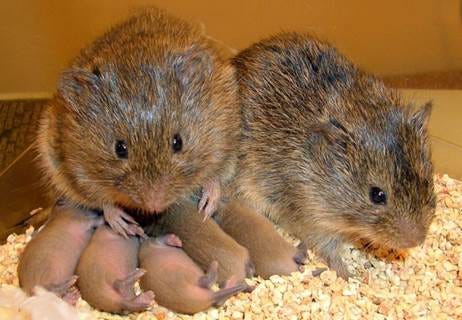
Most male mammals do not engage in hands-on (paws-on?) parenthood. Biparental mammals are interesting to study since they provide closer analogues to our own style of shared care. The prairie vole is a cute, furry critter known for forming long-term, monogamous pair-bonds and for providing both maternal and paternal care. Prairie voles like to cuddle with each other, and they seem to show empathy and helping behaviors, as well as parental care. Bonded pairs even show neural synchrony. Many of these prosocial behaviors seem to be motivated by the oxytocin system, and research on prairie voles has informed our understanding of mating and parenting within male-female couples. Plus, they’re very cute!
See previous posts in the “Mixed Bag” series.
Psychiatry at the Margins is a reader-supported publication. Subscribe here.

I love all of this! So cool to learn about your work. My husband read some books by Sarah Hrdy, so it’s fun to see her showing up in your writing. Thanks for sharing Darby Saxbe!
Thank you for a morning dose of positivity about parenting, and the surprise cute fluffy animals