


Sorbie Richner is a renegade independent scholar from the Midwest who writes on her substack, Miss Apprehension.
This essay contains descriptions of self-harm, suicide attempts, and suicides. It also contains spoilers for the film “Harold and Maude” (1971) and the show “The Haunting of Hill House” (2018).
Suicidality has been a main character in my life since I was a little kid. I started covertly making it other people’s problem starting when I was about 9 years old by externalizing it as rage and violence at home and bizarre behavior in school. It overtly became other people’s problem when I was about 11 and I started doing stuff like burning myself with candle wax and slicing open the bottoms of my feet. I was first hospitalized when I was 13, and went on to be hospitalized many more times for almost a decade. The behaviors that led to my (always involuntary) hospitalizations1 ranged from talking too openly about my desire to die, to very medically significant suicide attempts that landed me in the ICU. I haven’t been hospitalized in many years, I haven’t done what clinicians sometimes call “suicidal gestures” in as long. I’m not really sure what that means about the presence of suicidality in my life today, though. I’m still trying to make sense of what was going on all those years.
Most people who write about suicidality don’t know what the fuck they’re talking about, even clinicians who work closely with the suicidal. I know from reading a lot of books and papers and hearing a lot of Discourse that they know about suicidality in the abstract. They know what it looks like on someone else. I’m not the type to defer epistemically to “lived experience,” or to participate in “stay in your lane” kind of discourse. But even in the era of “mental health” discursive oversaturation, I have not heard that many frank discussions of suicidality by the acutely suicidal, formerly or otherwise. Maybe that’s because a lot of those people are in the psych ward, on the street, or dead. Regardless, those discussions need to be out there, and because they aren’t, we are seriously lacking conceptual, linguistic, and discursive tools to talk about this. So I’m going to be talking about my own experience a lot, because it’s what I know. It’s what I’ve got.
There were times in my life where the suicidality leaked out of me like juice out of trash bag on a hot sidewalk. At such times in my life where it was very public and obvious that something was wrong, a lot of people made misguided attempts to commiserate. “I know how you feel; I have taken prozac for a year.” “I know how you feel; I used to cut my wrists.” “I know how you feel, I have wanted to kill myself before.” These sentiments were counterproductive, because these people didn’t know how I felt. They made me feel like the enormity of the pain was invisible. They made me feel even more alone. In the rare times I did meet someone who knew how I felt (always in psychiatric hospitals and later rich girl rehab), I was so defensive against botched, intrusive attempts at sympathy that I was completely unable to let in genuine emotional resonance, which served to further isolate me. All people need emotional resonance. People who are suffering in ways that are taboo need it even more, because real resonance is all the more scarce. The stakes are high. Isolation with suicidality can kill people. It does kill people. The inverse instinct of inexpert attempts to commiserate is the instinct to send someone to the psych hospital. People who participated in getting me sent to the psych hospital believed they were helping me. They believed they were helping me get to a safe environment where I could stabilize. The psych hospital does not help suicidal people, not really. It further backs them into a corner, it frightens them into submission.
My tone may be coming across as callous to some readers. I think mostly what you’re picking up on is frustration. I’m frustrated that my freedom to talk about this topic was taken from me when I needed it most. It’s frustration in the psychoanalytic sense of the word, it’s the feeling that arises when a desire or need isn’t met over a long, long period of time. I still desire to talk about suicidality, and I still need to. And I needed to hear people talk about it back when suicidality was very active in my experience. I care about the needs of suicidal people. Mincing words and being overly gentle is NOT what suicidal people need. Suicidal people don’t need to be treated like they are ticking time bombs. Acting like you are scared of someone is a surefire way to isolate them and give them feelings of shame.
What is it doing there?
For many years, on and off in my teens and twenties, I was treated by a psychodynamic psychologist. One of the greatest strengths of our work together was that she didn’t fear my suicidality. She believed that suicidality, like any “psychopathology” or “maladaptive” behavior, was a mechanism that served some kind of intrapsychic purpose. She was able to hear me say “I want to die” and instead of immediately carting me to the hospital, she would let it be what it was. She would move closer to it instead of running away from it or rejecting it. Instead of trying to squelch it or exorcise it, she would say, “I don’t want to take away something that you need.” Her primary concern was not the suicidality would do to me, but what it was doing there in the first place.
My life from early childhood to my early twenties was characterized by being alternately idealized and denigrated by the people closest to me. I was a genius, then I was a disabled retard, then I was a genius again. I was beautiful, with refined, classic features, then I was ugly and I didn’t know how to dress myself, then I was beautiful again. My deep, strong emotions were a source of passion and empathic acuity, then they were the scary, dangerous, and volatile products of hysteria, then they were an empathic resource again. I was ruining this family, then I was sick and abject, then I was ruining this family again. This kind of treatment is objectifying, it’s dehumanizing: scapegoating is as objectifying as worship. It’s easy to see why denigration is objectifying; it’s a response to the needs of the person doing the denigrating, not to the reality and fullness of the person being denigrated. Idealization works by the same mechanism. And when the regard of your loved ones seesaws between the negative and positive poles of that mechanism, that makes it very hard to know what role you are supposed to play, especially when such seesawing is occurring during key developmental periods. It makes it impossible to know whether you’re going to be seen as a good object or a bad object on any given day. Nothing I did could possibly be right. Even if I was being good, I was being bad. That led to extreme feelings of helplessness and impotence.
I grew up in a very controlling environment. I don’t mean at home; my parents were actually very permissive (except for sometimes, when without warning and seemingly randomly they decided it was time to punish me, at which point they would rain down their wrath—this was another axis of unpredictability). I mean societally. I grew up on the upper end of the upper middle class in a city of rich liberal strivers. My city is home to a large tier one research university which is slowly subsuming the rest of the town. And let me tell you, that town is a pressure cooker. I estimate that half the girls I grew up with now have some severe form of anxiety disorder (GAD, OCD, you name it), anorexia, or both. Whether they would ever get treatment or diagnosis is another question: only those of us whose pathologies obstructed our productivity and our path to a competitive college got treatment when we were young; an inability to do schoolwork is how you know something is really wrong. Otherwise, extreme anxiety that gives you migraines and makes your hair fall out is just the cost of doing business in the professional managerial class. I was fucked up enough early enough in my life that getting me into an Ivy was out of the question, and I only became more fucked up over time. I had other shit to focus on: regulating my emotions and grasping at sanity was a full-time job; I didn’t have the capacity or desire to do that AND my mind-numbingly repetitive precalc homework AND read To Kill A Mockingbird for the 3rd time AND give a shit about the industrial revolution AND learn about the subjunctive mood in Spanish AND regurgitate information about the goddamn periodic table, let alone try to take AP classes. And yet, you can bet that the shame I felt about not being able to keep up or fit in with the Stanford-bound girls (or even the University-of-Michigan-bound girls) was overwhelming. In PMC world, the baseline for being a worthwhile adolescent is being a member of the National Honors Society, excelling in at least two sports (debate club or theater guild is acceptable, as long as you excel), playing a musical instrument at a high level, and volunteering at the Humane Society or the fancy old folks’ home. Suffice it to say that I was not a worthwhile adolescent by these metrics, and I felt it.
All this made me a terror at home, and it made me really weird outside the home. I struggled to make and keep friends, and the problem only worsened as I got older and weirder. My weirdness and confusing behavior was interpreted by those close to me as simple “cries for attention,” up to and including suicide attempts.
These events and circumstances made me feel crazy, worthless, isolated, alienated, furious, despairing, and above all, trapped. I developed a severe allergy to being confined or told what to do. I developed a chasm-sized need for human connection, and an equally large dearth of the skills I needed to have that connection. I developed a persistent need to get away, and I tried. I ran away from home several times. And I tried to kill myself several times.
And what is it, anyway?
Just now, I referred to my “persistent need to get away.” That speaks to an aspect of suicidality, but it doesn’t totally capture it. I find that as I am trying to look directly at it from the vantage of hindsight, it vanishes. So let me approach it by another route and see what I can see.
The distinction is often made between suicidal ideation (I want to kill myself) and suicidal intent (I have procured the weapon and I know when I am going to use it). That’s useful for clinical settings, i.e. deciding if your patient needs to be involuntarily hospitalized. By that metric, though, there are people out there who always have suicidal intent. For the purpose of thinking about my own experiences and writing this essay, I’m going to talk about the acuity of a person’s suicidality, i.e. how close they are to doing it. That’s less cut-and-dry, it’s squishier and more human, and for that reason I like it better for this discussion. Few things are more uniquely human than the self-conscious desire to die.
I also think that of the accounts of suicidality I’ve read in remotely mainstream media, most of those people were not that close to actually doing it—their suicidality was not very acute. This is based on my experience of having had suicidality so acute that I have survived several suicide attempts. It feels different. To one who knows what they’re looking at, it looks different.
People sometimes talk about some suicide attempts as being more “serious” than others. I think that’s true. There are things that everyone knows will kill you if you do them, and there are some that might or might not, and some that might not even hurt you very badly but will look scary. I have done all of those things, and I think each was motivated by something slightly different. I can only see that in retrospect; it is only possible for me to see from this place of temporal remove. From this perspective, I can see that the most acute suicidality is the suicidality of a dead person.
The following delineations can be made along the spectrum of suicidality:
(not suicidal)
I wish I weren’t here, I wish the pain would stop
I wish I were dead
I want to kill myself
I am going to kill myself (sometime in the future)
I am going to kill myself (in x amount of time) and I am going to do it by:
-a means that might hurt me
-a means that will likely hurt me
-a means that is likely to kill me
-a means that will certainly kill me(dead)
On the less acute end of the spectrum lie what clinicians sometimes call “suicidal gestures.” I would draw that line at “I am going to kill myself (in x amount of time) and I am going to do it by a means that might hurt me.” Harold of Harold and Maude (1971) gives us a cartoonish example of the suicidal gesture. (Yes, I really am talking positively about Harold and Maude in my essay about suicide, get at me.) I locate him on the above spectrum between “I wish the pain would stop” and “by a means that might hurt me.” He is straightforwardly making a bid for connection in his staged suicides. His mother writes him off as garishly seeking attention, and she is right. Harold is seeking attention in that he is asking someone to attend to his pain. Harold’s mother’s assessment of the events is correct. The meaning she makes out of it, “my son is acting up again to inconvenience or punish or mock me, and that’s all there is to it,” is not. If a person is “seeking attention,” it’s because they need attention. They need to be attended to.
By contrast, with no preamble and no warning, Maude quietly takes an action that she knows will kill her, and despite Harold’s best attempts to contravene, she dies. The behavior looks different because its motivations are different. Maude, after a long life of directly experiencing the extremes of humans’ will to dominate each other, a life of forcibly living under the terms of others, decides to die on her own terms.
Not to be like “this couldn’t be made today,” but Harold and Maude definitely couldn’t be made today. And yet, Harold and Maude provided some scarce emotional resonance for me when I first saw it some months after my first psychiatric hospitalization at age 13. That movie gets it.
When I was 15 I made a suicide attempt that necessitated the medical hospital (“by a means that might hurt me”) but the psych hospital decided not to admit me because they gauged that I was not in danger of actually killing myself. I had been in Harold mode when I made that attempt. I was in excruciating pain and was completely alone with it; I can see in retrospect that my suicidal gesture was communication more than it was a genuine desire to die. It was an expression of pain that was otherwise inexpressible. Of course, the communication fell on deaf ears. After I came back from my 18-hour hospital stay and getting my drugs rejiggered by my psychiatrist, my mom just made me go to school the next day and no one in my family ever spoke of the incident again.
When I was 20 I made a suicide attempt that almost killed me (“by a means that will certainly kill me”, but the stars didn’t align). I was in excruciating pain, I was completely alone with it, and I had learned by this point that no amount of communicating about it by any means would shift the pain or the aloneness. I had crafted a plan over many months. Because I knew I would die from it, it took me a long time to work up the guts to do it: even when you know that you very badly want to die, taking a human life is a serious act. Luckily for me, several acute stressors suddenly intersected in my life, and I knew it was time. I was in Maude mode when I made that attempt. This attempt was not an attempt at communication. It was an attempt to escape intolerable circumstances and intolerable pain. It was a last-ditch attempt to grasp at agency in a world where I didn’t have any. It was an attempt to do one thing on my terms. This shit is intolerable, and I don’t have to tolerate it.
What followed, because life is not a Hal Ashby film, was some of the most extreme control and domination of my life. The last thing I remember after arriving at the hospital was having my clothes cut off, then I was unconscious for some amount of time (I think it was a few days, but no one ever told me). When I got out of the ICU, I was unable to speak because of having been intubated. I was made to wear special scrubs so that I could be easily identified as a high-risk psychiatric patient, then when a bed opened up, I was moved over to the psych ward. Like at all psych wards, I was under constant surveillence. I was tranqed by injection against my will on several occasions. I was put on a new-to-the-market drug that made me very sick. When I was released, I was shipped back across the country to my parents’ house, where my family was very unhappy to have me there, and I was still drugged out of my mind on the crazy new drug. After about three months, I wound up in a different psych hospital, this time having been taken there in the back of a cop car. And then I was shipped across the country again to residential psychiatric treatment, where I remained for 9 months. The rest is history.
I think probably most people who flirt with suicide are in Harold mode. Goths and emo kids are in Harold mode. I think that most people who kill themselves are in Maude mode, and because of the nature of Maude mode, it’s not really possible to know that someone is in Maude mode until it is too late.
How did it get there?
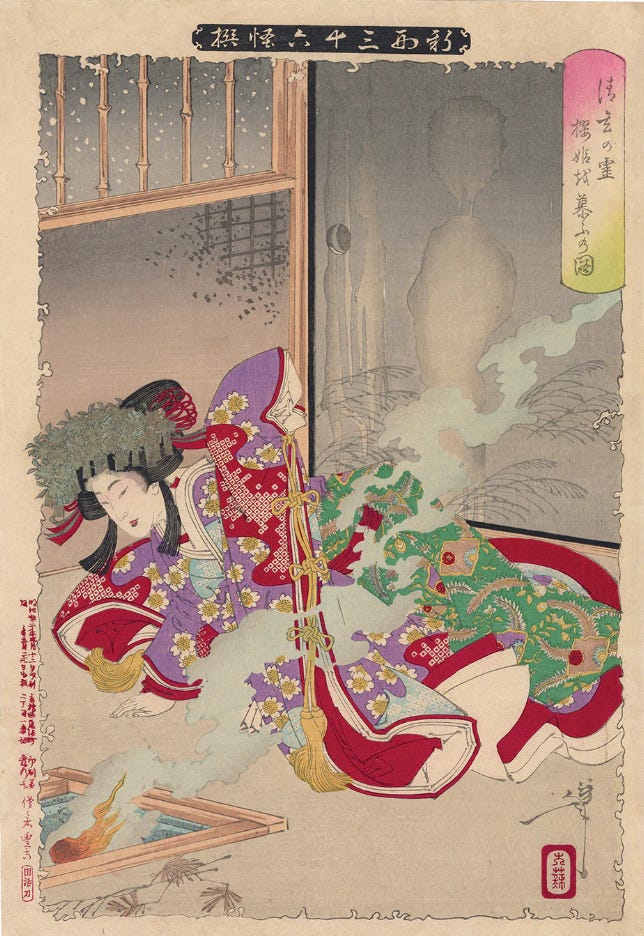
I remember when I was deep in the throes of it, I would sometimes see in my mind a shadowy figure. (You can see that information as literally or as metaphorically as you need to.) She would be closer or farther. The closer she was, the closer I was to dying. I remember long stretches of time where she was always in the room. She would approach me like a lover, coy and sensual. Sometimes she would stand over me. Sometimes we would breathe each other’s breath. She was so comforting. She wanted me to follow her. She wanted to take me away from the emptiness, loneliness, and profound suffering of my life. She wanted to take me home. She wanted me to join her in death.
I’m reminded of Nell in The Haunting of Hill House (2018). From the time she is a small child, Nell is visited by an apparition she calls “the Bent Neck Lady.” The Bent Neck Lady appears mostly at night. Her neck is twisted at an impossible angle, she has stringy hair and wears a long white nightgown (how original). She appears when Nell is alone and already frightened. Nell and her family are experiencing a lot of upheaval and instability, mostly due to the fact that Nell’s parents are house flippers who have chosen to flip a giant haunted mansion. The Bent Neck Lady begins her visits while the family is living in the haunted mansion. Her first visits also coincide with Nell’s mother’s descent into some kind of mysterious psychospiritual madness; she is possessed by the house and ultimately dies there. Nell and her father and her brothers and sisters flee the house. We don’t get to see what happens in the intervening years, but we learn that Nell continues to be visited by the Bent Neck Lady at night for twenty-odd years. She visits a sleep specialist’s office. She falls in love with the sleep technologist, and over the course of their courting, the Bent Neck Lady, who has now been explained away as simple sleep paralysis, stops visiting. Nell and the sleep tech get married and have a sweet life together, until one night, the Bent Neck Lady pays a visit. The sleep tech husband sits with Nell and gently tries to coax her out of the paralysis, but at that moment, he dies of a freak medical event. Of course, the meaning that Nell makes out of this occurrence is that the Bent Neck Lady killed her husband, the one good thing she had. She tries to cope with her loss by “normal” means (i.e. mediocre-to-bad psychotherapy), but such normal interventions do nothing to shift the magnitude of such abnormal pain. In a state of psychospiritual crisis, Nell eventually drives back to the haunted mansion to contend with the Bent Neck Lady. When she arrives at the haunted mansion, she finds it brightly lit and welcoming her home. We as the viewers can see that the haunted mansion is still dark and haunted, but Nell is in an altered state that makes her see it differently. She enters the house and instead of the Bent Neck Lady, she finds her mother and her late husband. We as the viewers can see that no one is there. Nell dies that night; she hangs herself from some scaffolding in the library. As she falls to her death, her life “flashes before her eyes”: she sees herself as a child in distress and then as an adult in distress. We find out that the Bent Neck Lady that Nell has seen her whole life is in fact herself in the act of dying.
I find it interesting that there are some traditional cultures that know of a suicide spirit. I’m not part of such societies, I don’t know what they know. I know what I directly experienced. In retrospect it is easy to see why a suicide spirit would gain purchase in my life. There weren’t just cracks in my spiritual armor, there were gaping holes. A suicide spirit could easily move in. Whoever was at work in my life, Bent Neck Lady or suicide spirit, she moved into the void where other forces could and should have been at work.
I don’t see that shadowy lady anymore. Sometimes I can feel her somewhere outside my house, somewhere in the neighborhood. But I wouldn’t feel drawn to her even if she showed up on my doorstep. The void that she filled no longer exists, because it is filled with love, meaning, and spiritual richness. I am free, so I don’t need to escape. I don’t need to return home, because I am already home. I don’t need her company, because I am surrounded by people who love me. But because she still shows up in the neighborhood, I am reminded how diligent I have to be in maintaining love, light, and connection to the divine. I don’t want to be tempted to follow her ever again.
This post is an edited version of an essay that was originally published on “Miss Apprehension.” Read the original here.
See also:


I didn’t read the post through, but what I read was terrific and useful. The way American medicine and psychiatry deal with suicidal risk is arbitrary and has more to do with our legal system and psychiatry’s role in medicine than any evidence-based intervention. I have appreciated a slight improvement from the beginning of my career 25 years ago, to now. But only slight. Private out-patient psychiatry allows me to almost entirely isolate myself from larger psychiatry’s approach to suicide and I am a more helpful clinician for it.
Appreciate this essay tremendously. It’s a gift to all of us readers, not to be taken for granted, that Sorbie made it through by— chance or grace— to this point where we can learn from her reflections.
One lesson learn from stories like hers, which I find incredibly useful: that suicidal thoughts and actions are meaningful, point to real and excruciating pain, immense loneliness or psychological isolation, and a deep relational/spiritual void where love and connection is needed. These are not to be ignored, glossed over, or medicalized.