


David Heath is a psychiatrist in Waterloo, Ontario, Canada, retired from clinical practice but active in promoting psychiatric hospitalization at home. He founded Canada’s first psychiatric hospitalization at home program in 1989 in Kitchener and a second program in Cambridge in 1998. His book “Home Treatment for Acute Mental Disorders: An Alternative to Hospitalization” was published in 2004 to excellent reviews in US psychiatric journals. He has given grand rounds and has delivered courses on the topic at annual meetings of the American Psychiatric Association. His website is www.intensivehometreatment.com.
This is a follow-up to:

I know of only two Psychiatric Hospitalization at Home (PHH) programs currently operating in the US. Neither Google nor ChatGPT could turn up any others. So you will be surprised to learn that the US has had more influence on the development of this model than any other country. The earliest randomized controlled trials (RCTs) were carried out in the US. A PHH program in Boston started as a pilot project funded by the National Institute of Mental Health (NIMH) in 1957, operated impressively like a modern PHH program, and in 1964 won the American Psychiatric Association Gold Award. Its founders wrote a handbook in 1967, much of which could be written today. One of the two research studies that provided the evidence base for both PHH and Assertive Community Treatment (ACT) took place in Madison, Wisconsin, in 1980. Three of the most influential thought leaders in PHH were American.
Ideally, innovations in mental health services are disseminated and, refined by research, build one on top of the other until mainstream, such as first episode psychosis programs. Instead, this history is a story of decades of … I’m not sure what… institutional amnesia?
Let’s start with Adolph Meyer, the first psychiatrist-in-chief at the Johns Hopkins Hospital, who was one of the most influential psychiatrists in the first half of the twentieth century.
His influence can be seen in the first-ever PHH program. It was established in the Netherlands by psychiatrist Arie Querido, who became the director of the Department of Mental and Nervous Diseases of the Amsterdam Public Health Board. Because of the financial problems of the 1930’s, he was asked to find ways to reduce hospital admissions.
Querido was influenced by the ideas of Meyer, whose mental hygiene movement was prominent in the US in the early twentieth century. Meyer thought mental illness had to be understood in relation to the whole person, their life history and their social environment, not just as a brain disease managed inside an asylum.
Similarly, Querido, instead of treating crises as something to be removed from the home and treated in the asylum, built services around home visits, family context and social conditions. He concluded that management at home was advantageous because the social difficulties creating the crisis were visible and amenable to intervention.
These ideas became a fundamental principle of PHH that to this day influences practice within PHH programs.
He instituted home visits by a social worker and a psychiatrist to all patients referred for acute admission. An alternative community treatment plan, sometimes involving follow-up visits, was formulated whenever possible.
The system he established attracted considerable international attention and in the 1960’s, 12 psychiatrists and 25 social workers were providing a 24-hour home-visiting rota for the whole of Amsterdam (Crisis Resolution and Home Treatment in Mental Health ed. by Sonia Johnson et al.) In 1956 a brief note in the Journal of the American Medical Association concerning Querido’s home visiting service in Amsterdam aroused great interest among American psychiatrists. Soon after, he was invited to the US to explain his program in greater detail.
As far as I can determine, psychiatrists at the Boston State Hospital were the only ones to have translated that interest into action. After some initial pilot studies, the NIMH awarded a grant to the hospital and the Boston University School of Medicine for a demonstration project: the Psychiatric Home Treatment Service.
Housed in the Administration Building of the Boston State Hospital, in 1957, the Psychiatric Home Treatment Service started out as a demonstration project and pursued its clinical goals within the context of a research demonstration. At first it consisted of a psychiatrist, a psychiatric social worker and a psychiatric nurse. Its catchment area was South Dorchester, a section of Boston with a population of 80,000 adjacent to the hospital.
Three directors or former directors of the program wrote a monograph describing this pioneering experiment treating mentally ill patients in their homes. It became fully operational with a staff of 20, including students, in 1962. In 1964 it won the Gold Award of the American Psychiatric Association.
Published in 1967, “Home Treatment: Spearhead of Community Psychiatry” by psychiatrists Leonard Weiner, Alvin Becker, and Tobias T. Friedman was designed to serve as a guidebook for hospitals and community agencies in establishing similar programs.
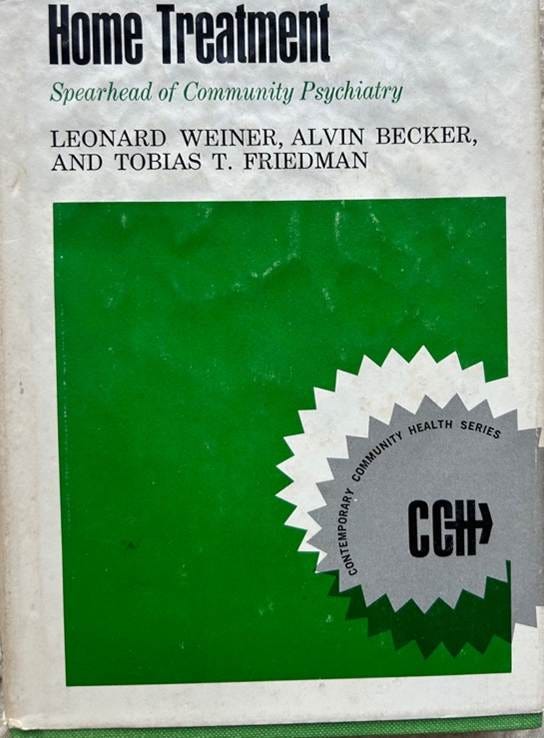
This is a remarkable book. The chapter headed “Manual of Operations” describes the principles and practices of the service. Apart from the hours of operation, these are identical to those listed in the British National Health Service’s “Mental Health Implementation Guide” on Crisis Resolution and Home Treatment (UK model of PHH) published 32 years later. This is the founding document that launched the NHS plan for 335 CRHT services throughout England; thus, England became the epicentre of research and practice in PHH. The English “template” of CRHT influenced the establishment of home treatment in 12 countries.
Reading this book, I felt a bit like an archaeologist who had discovered an ancient advanced civilization.
It is unclear how long the program continued to operate. The Boston State Hospital closed in 1979 and its functions were likely absorbed into the Massachusetts Mental Health Center programming but not as a distinct PHH.
Continuing the theme of American influence is a PHH program inspired by the Boston program at the Notre Dame Hospital in Montreal, Quebec, established in 1962. A report of its operation 1962-1964 in the Canadian Medical Association Journal shows that its principles and practice were in line with current PHH. As in the US, we see decades of institutional amnesia.
When on April 16 2024 the Quebec government announced a PHH pilot project at the hospital, there was no mention of an identical service operating 62 years before!
When I informed Montreal psychiatrist Olivier Farmer, one of the architects of the Quebec government’s plan to establish PHH throughout the province, of the existence of this PHH in 1962, he exclaimed, "Wow, really…. I had no idea, honestly. I first set foot in Notre-Dame as a student in 1999 and then as a psychiatrist in 2004.”
Americans were first out of the gate in randomized controlled trials of PHH. Four of the first five trials were American, starting with Pasamanick’s 1964 study in Louisville, Kentucky. This showed that patients with acute schizophrenia could be treated at home.
The largest intellectual influence on the development of PHH was Paul Polak, director of mental health research at the Fort Logan Mental Health Centre in Denver in the 1970s. He was the first to identify the role of conflicts and stressors in the patient’s social system in contributing to the need for hospitalization; 60% in fact, compared to factors in the individual.
Here he explains his ideas in his blog:
“When I left residency and went to work at Fort Logan Mental Health Center in Denver as Director of Research, I was concerned with the evaluation of treatment effectiveness of psychiatric hospitals. I quickly found out that people didn’t end up in the state hospital just because they were crazy. There were many people with crazy symptoms who never got close to a psychiatric hospital. For those who did end up in the state hospital, a major conflict in the patient’s family or primary living group was almost a prerequisite. As I gained more experience with the social process leading to hospitalization both at Fort Logan and later at Dingleton Hospital in Scotland, I came to believe that a social disturbance in the patient’s family typified by several unresolved crises a more significant determinant of admission than the patient’s psychiatric symptoms, and I began to evaluate and treat patients routinely in the context of their families in their real-life settings.”
This idea had legs.
It caught the attention of Australian psychiatrist John Hoult of Sydney, who later became the main architect of the UK National Health Service rollout of 335 CRHT programs.
Hoult had become dissatisfied with what he called the perseveration of the mental health system, in which patients get admitted to hospitals in a crisis. The precipitating social factors are not noticed and addressed; the emphasis is on symptoms and medication, and they are repeatedly admitted.
In 1977 he visited Polak’s service in Denver and incorporated his ideas into his PHH program in Sydney. Polak’s influence via Hoult was such that, according to Sonia Johnson, two of the four theoretical principles of CRHT practice can be traced to Polak.
These principles are
1. Treatment in the home environment is desirable because of the very large key role in many crises of difficulties in families and wider social networks.
2. Managing crises in the community is an opportunity for patients to develop skills and insights that will help them cope with their illness and with subsequent crises.
The story of American influence on PHH ended with the research and program development of psychiatrist Leonard Stein of Madison, Wisconsin, the second most important influence. His 1980 randomized controlled trial with psychologist Mary Anne Test was a giant leap forward in PHH research.
Their version of PHH, the Training in Community Living service, was more sophisticated than any previous studies and showed a deep understanding of the needs of chronically and severely ill patients. His team showed considerable resemblance to the current CRHT model. Stein’s study also influenced John Hoult, who decided to replicate it in Sydney in 1984.
Up to this time, all PHH teams were what are called “hybrid teams.” They had two components. Firstly, they were an alternative to admission for any patient in a crisis destined for admission. Secondly, after discharge, all these patients were then followed as outpatients, usually with no time limit. As Sonia Johnson points out, both Stein’s and Hoult’s services have the potentially confusing distinction of being cited as supporting evidence for two prominent service models: PHH and Assertive Community Treatment.
There are resemblances between PHH and ACT: both involve intensive contact with patients in community settings and integration of treatment of mental illness with help with social and practical problems. However, the populations served and timescales are different: PHH provides short-term treatment for mental health problems of varying type, severity and duration, while ACT is a long-term approach to the care of a selected subgroup who have severe illnesses and are especially difficult to engage and treat effectively.
In the mid-1980s, Hoult and Stein together decided it was unrealistic to expect one team to provide both crisis care for a broad range of patients and intensive community care for the particularly disabled subgroup requiring it. They recommended that the two functions be split into two services: short-term PHH for any patient destined for admission and ACT for long-term support of the most severely ill, difficult-to-treat patients.
In the 1990s, Hoult, taking with him the ideas of Polak and Stein, moved to Birmingham, UK, and became the first psychiatric consultant to the team in the Yardley area of Birmingham. This program has had an extensive influence on the development of the British NHS plan to develop 335 CRHTs, of which Hoult was the major architect.
So, to summarize, the current British CRHT model was influenced by Leonard Stein and Paul Polak via Australian psychiatrist John Hoult. Since about 2000, CRHT has influenced the creation of PHH teams in 12 countries—most recently in Canada in the province of Quebec.
However, in the US, PHH seems to have “died at birth” — except one team set up by Stein at the Dane County Mental Health Centre where he became the director in 1974 (Johnson)
Surely, the time has come for psychiatric hospitalization at home?
Awais says there is a need for a strong moral vision that places the clinical needs of people over the needs of the health care system, i.e., a clear, convincing rationale for PHH.
Home hospitalization avoids hospital-related harms, states Awais. A common view among experts is that hospitals disrupt all aspects of patients’ daily lives, and this may damage their social networks and social functioning. Hospitalization is an unpleasant and alienating experience and may result in even greater stigma than being diagnosed as mentally ill.
These ideas about hospitalization appear to have been one of the main motivations for the Quebec provincial government’s plan to institute PHH province wide—the first provincial or state government in North America to do so. In his announcement of this in October 2023, the social services minister described avoidance of hospitalization as the rationale. “Hospital is a negative stigmatizing experience, which, if prolonged, will hinder their self-determination, autonomy, and recovery process.”
One benefit of PHH in my experience is that it decreases the need for involuntary admission. Over my eighteen years of experience treating severely ill patients at home, I came to the conclusion that for many patients, it’s the hospital that they are refusing, not the treatment. Even if they refuse treatment at first, many can be persuaded to accept it, often with the encouragement of their families and other supports.
There is little research on this topic, but one study stands out: a PHH program initiated in the famous mental health system of Trieste Italy, a city of 240,000. The site of a WHO collaborating centre with the goal of disseminating its practises across the world. It’s the one place psychiatrist Allen Frances says he would wish to be if he had a severe mental illness. He’s visited it five times.
Compulsory admissions in Trieste were rare, and by 2005 there were only 15 cases that year due to the practice of “relentless negotiation” with uncooperative patients sometimes over many hours. And yet, they felt the need to reduce these even further and, to that end, in October 2017, created the Home Care Crisis Attention Team.
Within one year the compulsory admission rate was reduced by 78.7%.
A 2003 study in County Monahan in Ireland saw the compulsory admission rate reduced by over half, a third of the national rate, after the creation of PHP.
There is a theme running through research and commentaries regarding PHH, of hospitalization being necessary but best avoided if possible.
During my work, first as a medical director of a psychiatric ward, then as the founder of two PHH programs, I have formed a list of patients who one would expect to have particular difficulty in adjusting to psychiatric hospitalization.
Patients with postpartum disorders, those who are developmentally delayed, refugees and recent immigrants who don’t speak English, first-episode psychosis patients, and homeless individuals.
The theme of hospitalization being necessary, but best avoided by referral to PHH if possible, also runs through the clinical guidelines of the UK’s influential National Institute of Health and Care Excellence (NICE). Their guidelines for the management of acute schizophrenia, bipolar disorder and severe depression all recommend PHH rather than admission if possible. Guidelines for patients with borderline personality disorder, similarly recommend referral to PHH and emphasize only admitting to a hospital if there is significant risk to self or others that cannot be managed by other services or for detention under the Mental Health Act.
The advantages of PHH treatment over hospital treatment for patients with borderline personality disorder were illustrated by the experiences of the Adult Psychiatric Home Support team—a PHH program in Edmonton, Alberta, which I visited for my book. This program was founded by psychiatrist Richard Hibbard, who had a special interest in the treatment of these patients.
Consequently the staff had become competent, comfortable and effective with these patients, and also with those with narcissistic and histrionic personality disorders who often present with self-harm.
Over the years, staff had often dealt with these patients both in the hospital, and then subsequently, in the PHH program. They found them easier to deal with in the PHH program.
A firm three-week limit to length of stay limits dependence; the patients get more time with staff than on the ward; and a firm, consistent approach to head off splitting is easier with a small, close-knit team.
Acting out in the community is less: “It’s their stuff, they are not going to throw their own belongings, or run away from their own home.”
The limited research evidence in support of PHH is often brought up by commentators.
Randomized controlled trials are generally seen as the gold standard form of evidence regarding treatment in medicine, though it has been argued that the complexity of interventions and the many factors that make their outcomes vary between settings limit the usefulness of this scientific method in mental health services research.
An additional problem in PHH research has been the changing ethics of RCTs. The investigators in the 2005 North Islington RTC, mentioned by Awais, came to understand why so few randomized trials of PHH had been published (Johnson). The main challenge is that people presenting in a crisis may transiently lose their decision-making capacity at that time.
Unlike today, in most of the studies conducted in the 1970s and 1980s, everyone referred for hospital admission was randomized at the time of the crisis without first seeking consent. The N. Islington investigators went through an arduous complex procedure to overcome this. Consequently, there were no RCTs after that until the 2020 Swiss RCT cited by Awais.
The latest RCT is a 2022 Dutch study that found a 36.6% reduction in hospital days in the experimental group, but no difference in the number of admissions. Investigators overcame the ethical challenges by using a modification of the traditional RCT, called a Zelen design, in which participants are randomized before the consent stage.
These problems with RCTs can be avoided with quasi-experimental studies that compare two time periods, before and after the institution of a PHH program, or of two areas, one with and one without a PHH program. The main challenge here is whether the two groups are otherwise equal.
The most recent quasi-experimental study was carried out in Switzerland in 2022, where allocation of patients for acute treatment to PHH or the hospital depended on place or residence.
Results showed that PHH can replace an inpatient unit.
Two quasi-experimental studies in the UK showed reductions of admissions of 37.5% (Leeds) and 45% (Newcastle) but are dated (2007).
A sign of the maturity of the PHH model is the creation of a fidelity scale. Fidelity measures are tools to assess the implementation of interventions or program models and as such can help address the major challenge for mental health services of translating scientific knowledge into patient benefits.
Development of fidelity measures for complex interventions in mental health services has been advocated not only as a means to define an intervention and measure services’ adherence to the model specified, but also to suggest service improvement.
In the US Evidence-based Practice Project fidelity scales have been developed for complex mental health services such as Assertive Community Treatment.
In 2016, a group at University College London developed the CORE fidelity scale. It’s a 39-item measure of CRHT with good face validity and promising initial testing, indicating its value in assessing adherence to a model of CRHT best practices.
Item 6 in the fidelity scale is that the CRT has a fully implemented “gatekeeping” role, assessing all patients before admission to acute psychiatric wards and deciding whether they are suitable for home treatment. This is supported by a strong expert consensus, with PHH seen as much less able to reduce admissions if they do not automatically assess every potential admission for suitability for home treatment.
John Hoult specified this requirement from the start. In the 1990s he worked with a PHH program in Sydney, Australia, where the admission rate was halved. After he left, the admission unit was moved from the local mental hospital to a teaching hospital, where the new doctors did not routinely call the PHH team: admission rate and bed usage reverted to the previous level.
This phenomenon of resistance to referring patients to PHH was evident in the PHH program at Boston State Hospital in the 1960s described above. Eventually, it was mandated that all doctors who intend to send patients to the hospital must first get in touch with the PHH program.
When I was visiting PHH services in UK for my book, I met the chief psychiatrist of a hospital who railed against her colleagues who regularly, against established policy, bypassed the PHH team and admitted their patients. “I’m supposed to be their boss,” she lamented.
I heard PHH staff complain of psychiatrists bypassing their service and admitting patients who would be suitable for home treatment while visiting PHH programs in Edmonton, Alberta, and Victoria, BC, for my book.
The PHH service I founded in Cambridge, Ontario, in 1998 was discontinued some years after I left in 2007. I understood one of the reasons was that most of the referrals had originated from one psychiatrist who was an enthusiast of PHH. When he left the hospital, patient numbers shrank.
In a centrally controlled mental health service like the UK NHS, where psychiatrists are employees paid by a salary, gatekeeping works, but I can’t see how it would be possible to institute this in the Canadian health care system.
Sustainability of PHH is an issue according to Hoult (Johnson), who wondered why many teams in other countries have not been sustained. This has been a problem in Canada, where, apart from Quebec, teams were founded by local enthusiasts like myself and were often the only ones, or one of a few, in the province. Over the years in Canada four PHH programs in three provinces were not sustained. Certainly the lack of support from local psychiatrists didn’t help.
Although there is little evidence about this in the literature, Hoult says, the likely answer is they have not been seen as an integral part of the total service system and/or that they have failed to demonstrate their usefulness and effectiveness, thus becoming easy targets for cutting when times become difficult. He outlines principles for ensuring sustainability.
Staff burnout and low morale have been raised as a concern in those contemplating creating a service. However, two studies in the UK have demonstrated good morale, and scores of the three components of burnout were low or average in PHH teams, in contrast to Assertive Community Treatment teams and community mental health teams.
Awais raises the issue of PHH services being very complicated and creating a service being a daunting task.
That seems to be one of the reasons why I have been unsuccessful in getting Ontario’s Ministry of Health (MOH) to develop PHH programs, according to one high-ranking mental health services administrator, who told me that the MOH lacked people with the requisite skills and experience. One Canadian expert told me a specific “technical assistance center” would be required to create a PHH team.
When Vancouver General Hospital in BC replaced an 18-bed psychiatric ward with a PHH program, they hired Accenture—a large consultancy—for project management.
Canada does not have mental health technical assistance centers like SAMHSA does; could these play a role in providing PHP services in the US?
The shortage of public psychiatric beds in the US is a serious problem. The Treatment Advocacy Centre (TAC) advocates for 50-60 beds /100,000 population; currently there are 11.7 /100,000 population.
I could not find any mention of mitigating this shortage by PHH programs. And yet, these may be the only solution to this bed shortage. What are the chances that states are going to build new bricks-and-mortar psychiatric wards?
PHH is cheaper than inpatient care and requires little or no capital expenditure. A detailed review of PHH in the Psychiatric Services journal analyses cost savings. PHH programs can provide an alternative to admission for about a third of patients, plus early discharge for 40%.
But what if the possibilities for diversion of seriously mentally ill patients from hospitalization can be extended by boosting PHH programs with acute day hospitals and supervised crisis and other residential services?
These combinations are not uncommon in the UK but have not been evaluated.
A clue as to how far these combinations could make up for the shortage of beds can be found in a study carried out in Montreal, Canada, in 1996. Even though this study is 30 years old, the design of what was called Intensive Home Care is different from the current PHH design and the setting and healthcare system are different from the US, I think the types of patients and the service models are similar enough to provide the TAC with food for thought.
Instead of mental health planners and bureaucrats determining the role of hospital alternatives (top-down decision-making) it was the patients’ attending psychiatrists who determined what their patients needed at the time of admission (bottom-up decision making) and the results were surprising.
This methodology was pioneered in London and Nottingham, UK, in the mid-1990s. The instrument used is the Nottingham alternative to bed utilization schedule (NABUS).
This comprises 3 sections. The first covers the need for key elements of the care package, including residential alternatives, what the authors call Intensive Home Care (2-6 hours weekly), and day care. Residential alternatives include supervised apartments, supervised hostels, halfway houses, and crisis centers.
The setting is the Louis-H. Fontaine Hospital in the east end of Montreal, once the largest psychiatric hospital in Canada. In the 1980s the hospital decided to curtail access to long-stay beds, thereby creating a defacto pool of new long-stay patients in acute wards in the absence of alternatives for these patients.
The NABUS was translated into French, and operational definitions were developed for the 3 alternatives. At the time of the study, neither Intensive Home Care nor a Day Hospital was set up. Diagnoses were: organic brain syndrome 10%, psychoses 40%, major mood disorders 38%. 64% patients lived in their own homes.
Analysis showed that a package of care, rather than separate alternatives to hospitalization, was the most recommended: IHC combined with residential alternatives or day care.
This left a floor level of 18 acute care beds per 100,000 population required. On a given day, only 62 of 212 patients were unsuited for any alternative to acute care hospitalization.
These results were surprising. It was expected that local psychiatrists would be hospital-centered and resistant to bed cuts. They were not familiar with day hospitals and Intensive Home Care. Instead they favored care packages that delivered treatment in the homes or residential settings of patients in their community.
The effectiveness of PHH turbocharged by an alternative residence is evident in a unique program founded by psychiatrist Olivier Farmer in 2013 in Montreal—the PRISM program. PRISM (Projet de reaffiliation en itinérance et santé mentale) is the French acronym for the Homelessness Mental Health Reaffiliation Project.
Its target population is homeless people with psychosis—schizophrenia spectrum disorder and severe bipolar disorder, often with comorbid substance abuse. It is often the service of last resort.
PRISM is psychiatric hospitalization at home, where home is a homeless shelter. Clients live in a separate dedicated space within the shelter that provides private or semi-private rooms, a lounge with sofas, TVs, and computers. They get all their meals and can come and go as they please.
Treatment is provided by an embedded team consisting of a full-time social worker, a half-time nurse, a part-time psychiatrist, and a full-time shelter support worker. The clinical staff are employees of a hospital where the psychiatrist can admit patients. The service has multiple partnerships, most prominently with Housing First organizations. Clients have to agree to receive treatment and to seek housing. They pay $335 /month rent from their social benefits. The main goal of the program is to get the clients well enough that they have the capacity to engage with a Housing First program and other supports.
After 8-12 weeks, 76.7 % achieve stable housing. 78% are linked to ongoing mental health supports with a warm handover, and 62% are still housed after one year. 75% are treated with a depot intramuscular antipsychotic.
There are now six PRISM programs, one of them in Quebec City.
Finally, to end on a positive note, on January 5, 2026, the history of PHH came full circle in Boston, 62 years after the Home Treatment Service at Boston State Hospital was awarded the APA Gold Award.
That day, the Massachusetts General Behavioral Health Home Hospital (BHH) in the Boston area launched a pilot randomized trial of home-based acute psychiatric care for a highly selected lower-risk subset of adults who would otherwise have needed inpatient psychiatric care.

Hi Michael, I understand you have EPSIAD teams in France -similar to Crisis Resolution Home Treatment teams ?
What do you think were the reasons you weren't getting referrals and how extensive is the problem ?
This is such a common feature of PHH it is ripe for a research project.
How many of these teams are there and how are they functioning overall ?
Hi Inez, of course some manic or psychotic patients could not be handled in a PHH program, however, many admitted can be discharge fairly early to home treatment, even after a few days of good sleeps and starting on meds. However in my service we have treated numerous such patients without needing to admit them.
A surprising number of them can be cooperative with the right approach. Families are often very keen to avoid hospital admission , especially if the patient has had a previous bad experience, and will go to great lengths to avoid it. They can help us engage them and monitor them and supervise medication
Rapid control of agitation from the start is very helpful
I cover this in chapters 7 and 8 of my book. In Awais' piece linked to this, there is a link to free access of my book