


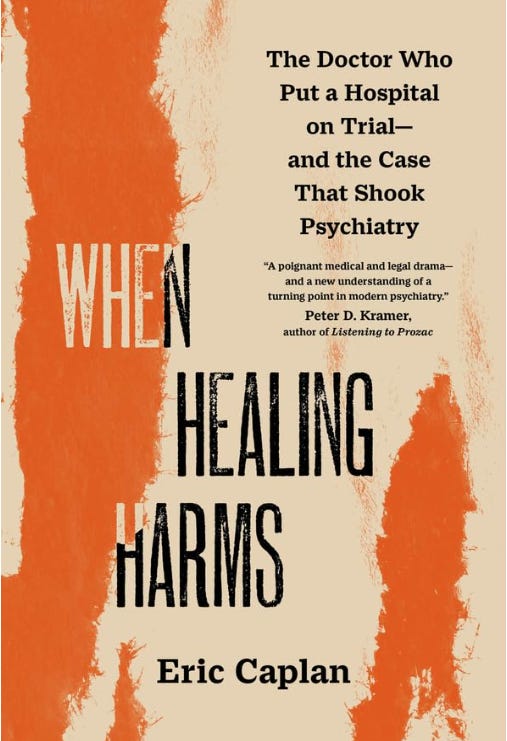
Eric Caplan is a historian of American psychiatry and the author of “Mind Games: American Culture and the Birth of Psychotherapy” (1998). His forthcoming book, “When Healing Harms” (University of California Press, October 2026), reconstructs the landmark malpractice case of Osheroff v. Chestnut Lodge from primary sources never before examined, revealing how the lawsuit accelerated the transformation of psychiatric practice in the United States.
Aftab: Tell us about the subject of your book. Who was Ray Osheroff, why did he sue Chestnut Lodge, and why did this case attract so much attention? What are some common ways in which the Osheroff story is misunderstood or misrepresented?
Caplan: Raphael Osheroff — Ray — was a nephrologist, a kidney doctor. In 1979, under pressure from his wife and colleagues, he admitted himself to Chestnut Lodge, among the most prestigious and expensive private psychoanalytic hospitals in America, expecting world-class care for a severe depression. Instead he was confined to a locked ward, denied medication, and subjected to seven months of talk therapy. He emerged forty pounds lighter, unable to use utensils, physically frail and emotionally devastated — not because his treatment failed, but because treatment was withheld. His parents secured his transfer to a hospital willing to prescribe the antidepressants he needed. But the damage was done. His marriage, his practice, and his reputation all lay in tatters. He then sued Chestnut Lodge for denying him the standard of care to treat his illness, which in 1979 comprised pharmacotherapy, or pharmacotherapy in conjunction with electroconvulsive therapy (ECT), and supportive psychotherapy.
At Chestnut Lodge, treatment was exclusively psychoanalytic. Four sessions of talk therapy a week and what they called milieu therapy, in a structured and controlled environment. In Ray’s case, the psychotherapy he received was confrontational, not supportive. He was told he was symbolically dead. That he would spend the rest of his life on a locked ward at Chestnut Lodge. When he asked when he might be discharged, he was told, “when you stop using your shirt for a napkin.” He was denied access to a telephone. He was not allowed visitors. He was allowed to pace between 12 and 18 hours a day. His continuing pleas for medication were denied — because, he was told, he “would need every neuron to fight this disease.”
The lawsuit was eventually settled out of court and Chestnut Lodge agreed to pay Osheroff. It was widely seen as a victory for Osheroff and a functional acknowledgement on the part of Chestnut Lodge that the standard of care had been violated.
The Osheroff case is well known among psychiatrists. As it should be. But what is well known — that the case represented the triumph of biological psychiatry over psychoanalysis in the treatment of serious mental illness — is not so much insufficient as incorrect.
A malpractice case is ultimately about one thing: Did the patient receive the standard of care for his condition? If he did not, and his condition worsened as a result, that is malpractice. Full stop.
That is what the Osheroff case was about. It was not about whether drugs were better than psychotherapy. It was about whether Chestnut Lodge violated the standard of care by treating Dr. Osheroff’s diagnosed condition — initially manic-depressive illness, later revised to psychotic depression, agitated type — with psychoanalysis alone, while confining him to a locked ward with eleven other patients, ten of whom had been diagnosed with schizophrenia.
Failing to prescribe medication and/or ECT for Osheroff’s condition in 1979 was akin to treating tuberculosis in 1979 at a mountain sanatorium — think Thomas Mann’s The Magic Mountain — and refusing to prescribe antibiotics for fear that they would interfere with the mountain air. Compounding matters, as Osheroff’s health deteriorated at Chestnut Lodge, his decline was not understood as evidence that the treatment was failing. It was interpreted as evidence that the treatment was working: he needed to get worse before he could get better. That conviction followed from the particular psychoanalytic doctrines that had shaped Chestnut Lodge since the 1930s and had been associated with figures such as Frieda Fromm-Reichmann and Harry Stack Sullivan, who hypothesized that early life trauma was, if not the sole source of disturbances of mood, thought, and behavior, then the primary one. And that “cures” required years of psychoanalytic treatment — first regressing the patient to the point of trauma, and then “reconstructing” the personality from the ground up.
Aftab: I was talking once to a psychiatrist who was early in her career when the Osheroff lawsuit happened, and she remembered feeling disgust at the intellectual “arrogance” displayed by experts from both biological psychiatry and psychoanalytic psychiatry during the trial. What was your reaction as you went through the historical records?
Caplan: Psychiatry has unearned confidence in both its theories of mind and its theories of brain. This is hardly unique to psychiatry. On the contrary, unearned authority — by which I mean strongly held convictions or theories without sufficient evidence to justify that confidence — is ubiquitous. Indeed, it would not surprise me if those reading this transcript accused me of the same, much as I like to believe mine is earned.
Psychiatry has given us both the Oedipus complex and the chemical imbalance — to say nothing of a host of other two-to-five-word catchphrases. What it has not given us, not yet, are mechanisms that correlate with those theories. That does not mean the theories are wrong. It does not mean the mechanisms do not exist. There is no way to know today. I cannot speak to tomorrow.
But not knowing is not a license to do nothing — to tell patients, well, come back in a decade and maybe we can help. We would not send a mission to Mars until we had reasonable confidence that it might succeed. But we cannot simply refuse to treat people with serious disturbances of mood, thought, and behavior who want treatment. For those who do not want treatment, that is a different issue, and it has little to do with what psychiatry has or does not have in its toolkit.
In Dr. Osheroff’s case, he actively sought treatment. He was not naïve. He knew he was ill. And he sought the best care psychiatry had to offer — psychotherapeutic, psychopharmacological, and neuromodulatory. He also voluntarily, if one can ever quite call it that, admitted himself to a well-regarded and expensive psychiatric hospital on the recommendation of his treating psychiatrist at the time, Dr. James Wellhouse. Wellhouse recommended Chestnut Lodge rather than Sheppard Pratt in nearby Towson, Maryland, because a bed was available, and he assumed, erroneously, that Osheroff would be treated with medication and/or electroshock, as that was the standard of care in psychiatric hospitals in 1979. He was wrong.
Aftab: If we look at Osheroff’s life and psychiatric history after the lawsuit, does it offer any simple vindication to either the psychoanalytic or the biological psychiatry camp in terms of the nature of his psychological difficulties?
Caplan: When it comes to providing care that helps patients, there are no sides. There is only the patient; the illness or disorder disrupting the patient’s life and the lives of loved ones; and, in the case of mental illness and infectious disease, the question of whether that illness adversely affects the broader community.
If an intervention of any stripe mitigates that suffering, that is, in most cases, a good thing. If it does not, it is not.
Osheroff’s history after Chestnut Lodge is complicated. He married again, and divorced again, and after his fourth marriage failed he fell in love once more. He practiced medicine until his death in 2012. He never experienced another life-threatening depression, but he continued in psychoanalytic therapy for three more decades, and when a depressive episode struck in 1999, he opted for ECT at Hillside Hospital in Queens, administered by Max Fink, arguably the most eminent and experienced proponent of ECT in the United States, if not the world. With Henry Kellerman, a distinguished psychoanalyst and the author of more than forty books, he co-wrote an unpublished manuscript about his time at the Lodge.
He was widely admired by patients and colleagues — I came to possess hundreds of letters from across his career that attest to it. The praise is effusive. Those who knew him before Chestnut Lodge spoke of his intelligence, his medical acumen, his sense of humor, and his musical gifts; he was a regular banjo player in a bluegrass band and a talented trumpet player. He was loved by many and detested by some. Rachel Aviv documents his DUI arrests and an indictment for Medicaid fraud that ended in a de minimis fine. Yet he never achieved what he most wanted: the love and respect of his three children, all of whom severed relations with him and remained estranged for the better part of his final two decades.
Whether he had a personality disorder — whatever those may be — remains contested, and I am agnostic. Many who knew him best, Kellerman among them, insisted he did not. What he suffered from, Henry told me, was a repetition compulsion: the conviction that if only he could make others understand the horror of Chestnut Lodge, he would be vindicated and his children would love him again.
In any case, I think the personality-disorder question is something of a red herring. Chestnut Lodge held that personality disorders were incompatible with “biological depression,” which is rather like saying heart disease is incompatible with cancer. A narcissist is not immune to depression. Otto Kernberg, among the leading authorities on narcissism, argued not only that the two diagnoses could coexist but that when they did, the depression had to be treated first. And there is no evidence that a narcissistic personality disorder requires years of hospitalization, or any hospitalization at all, which is what Osheroff’s doctors believed his condition demanded.
Aftab: The Osheroff case has been the subject of extensive discussion in the past. There is some discussion of it in Jonathan Sadowsky’s The Empire of Depression (2020). More recently, Rachel Aviv devoted a chapter to it in her 2022 book Strangers to Ourselves. You must have believed that existing discussions were incomplete in some important way and that a book-length treatment of the subject had more to offer us. What does your book add to our understanding of this historical episode?
Caplan: Jonathan Sadowsky’s treatment of the Osheroff case is based largely on the Klerman–Stone debate. Rachel Aviv asked a different question from mine. Her interest was in how psychiatric encounters and psychiatric nosology shape both a sufferer’s perception of his or her diagnosis and the broader community’s conception of that person.
The question I asked was different: How did Osheroff’s lawsuit — and the work of his extraordinarily brilliant counsel, Phil Hirschkop — affect the practice of psychiatry, and of medicine more broadly? That question demanded a different approach from Rachel’s: less biographical, more historical. Each of us, of course, has elements of both; what differs is emphasis and scope. It also required a much larger documentary record. I interviewed Al Scanlon, the attorney for Chestnut Lodge; David Fudala, one of Osheroff’s attorneys; people who knew Ray intimately; and others connected to the litigation and its aftermath. My interviews are recorded and on the record. I also worked through an extensive archive of legal records, correspondence, medical records, and other primary sources.
I began the project wanting to conclude that Osheroff’s lawsuit had transformed psychiatry. The evidence would not let me make that argument. What it supports, I think, is something subtler: the case was catalytic. It mattered. But the post-Osheroff world would probably not look dramatically different from the one we inhabit today, because equally significant secular changes were already reshaping medicine and psychiatry.
That distinction matters to me. The historian’s job is not to make the story more consequential than the evidence permits. It is to determine, as closely as possible, what actually happened and what difference it made.
As for Rachel’s question, my answer is that once a disease or disorder is tamed, the stories that traveled with it largely disappear, and with them the sense of identity the illness once conferred on the afflicted. I wish I could take credit for this interpretation. I cannot. It belongs to Susan Sontag, to her Illness as Metaphor, which remains no less trenchant today than when it was published almost half a century ago, in 1978.
Aftab: The Osheroff lawsuit was four decades ago. Why should we care about it today?
Caplan: Because while theories change and treatments change, if sometimes only a little, the mysteries of the brain and mind remain remarkably opaque. We continually substitute metaphor for mechanism. That is not necessarily to the detriment of patients; treatments can work even when our explanations for why they work are incomplete. But it can be to the detriment of confidence in a profession that cannot afford to be cavalier about the difference between a useful theory and an established mechanism.
Medicine does this elsewhere, too. Think of the familiar language of “good cholesterol” and “bad cholesterol,” which is a crude explanation of a far more complicated biological process. But cardiology also has statins, PCSK9 inhibitors, bypass surgery, pacemakers, ICDs, and even transplantation. Against advances of that magnitude, psychiatry’s best interventions can sometimes appear remarkably primitive.
The Osheroff case therefore remains relevant not because it settled an old war between psychoanalysis and biological psychiatry. It did not. It remains relevant because it asks an enduring question: What do physicians owe patients when their theories are uncertain but the patient’s suffering is real?
Aftab: Do you feel comfortable saying something about your own history of psychiatric diagnosis and treatment? Are there any connections between your experience and what Osheroff went through?
Caplan: I do not think I could have written this book if I did not know what depression is. And I do not think I could know what depression is if I had not experienced it firsthand. I suspect Andrew Solomon and Rachel Aviv would say something similar.
That said, I do not think — though others may disagree — that my experience clouded my judgment. Of course it shaped it. The relevant question for a reader or reviewer is whether my evidence supports my claims.
One of the things I am proudest of is that I made the archive of primary sources available to readers with the click of a mouse. The online supplement, whhsources.org, recapitulates my chapter “On the Evidence” and my notes, with a link appended to each note, where legally permissible, that takes readers and reviewers directly to the underlying primary source.
I believe in evidence-based scholarship. The point is not that readers should trust me. The point is that, wherever possible, they should be able to examine the evidence themselves.
Aftab: It is notable that your book garnered advance praise from prominent figures belonging to, so to speak, antagonistic ideological camps — for example, Peter Kramer, Paul Appelbaum, Andrew Scull, David Healy, and Robert Whitaker. I suppose it speaks to the power of good historical scholarship that it can bring people together in this way. Perhaps there is also the fact that the Osheroff case has a Rashomon-like complexity to it and people see in it what they want to see. What do you make of it?
Caplan: I had only a fleeting acquaintance with Peter Kramer. I did not know Paul Appelbaum or Robert Whitaker before I sent them the manuscript and asked for feedback. I met David Healy at a conference about thirty years ago, and we spoke again when I was beginning this project, but he was an acquaintance, not a friend. Steve Hyman also read the manuscript and gave me valuable feedback. As did William Potter, who both treated Dr. Osheroff briefly after his discharge from Chestnut Lodge and evaluated him as part of the process to restore his medical license and hospital privileges. Potter also testified as an expert witness in the Osheroff case, arguing that Chestnut Lodge had violated the standard of care for manic-depressive illness — the primary diagnosis Osheroff received on his admission to Chestnut Lodge on January 2, 1979.
What interests me about the range of responses is precisely that these people do not occupy a single intellectual camp. They disagree, sometimes sharply, about psychiatry, its history, its treatments, and its institutions.
I do think the Osheroff case has a Rashomon-like quality. It is remarkably easy to find in it whatever argument one arrived wanting to make: psychoanalysis versus drugs, mind versus brain, autonomy versus medical authority, psychotherapy versus biological psychiatry. But that is also the trap.
My aim was to resist it. I wanted to reconstruct what happened from the documentary record and then let the evidence constrain the argument. If readers who disagree profoundly with one another about psychiatry nevertheless find the history persuasive, I take that as a good sign. They do not have to agree about psychiatry. They only have to agree that the evidence has been treated fairly.
Aftab: Thank you!
This Q&A is part of a series featuring interviews and discussions intended to foster a re-examination of philosophical and scientific debates in the psy-sciences. See prior interviews here.
Thank you so much for this. This idea has been floating around for me for a while that psychiatry (maybe a relative of Malcom’s “Psychoanalysis the impossible profession”) at the very core is a dynamic multidisciplinary multidimensional field of uncertainty that weaves the physical experience of biology, physiology, neuro anatomy, inflammatory processes, neurotransmitters, receptors, networks, electricity, plasticity, cellular functioning into more abstract territories— developmental frameworks, our rudimentary understanding of consciousness, inter subjective theory, affect and the complex interactions of environment on subject. Psychiatry is a Sisyphean task at best to expand broadly and deeply enough to integrate philosophy, art, cultural and political forces, biology, technology, chemistry, physiology and anatomy (to name a few). And to make an interpretation, we cling arrogantly and stubbornly to theories and practices that make us feel legitimate because it is too humiliating to admit that we are looking through a pinhole. And have no idea actually how to understand the complexities of brains in bodies with strands of genes stretching back through time and environments that exert pressures and shape how we experience reality. Being a psychiatrist is, to me, the most profoundly complex practice. We walk in the dark, we do not know what we do not know, and we are confronted with the fundamental struggles of grief, neurosis, relationally, despair, suffering, and how a medication can shift the kaleidoscopic experience of being a human on earth. Godspeed to all who enter this path. I am forever slightly embarrassed by our field and continually drawn to the expansiveness it requires. For me, it is the intellectual sustenance of needing to know more. But never actually knowing the answer. Humility, a sense of humor, and a profound belief that everyone deserves to be actively and attentively listened to and attuned to are what make it possible to do this. Without connection, what the hell are we doing? Great interview.
David, I accept your critique. I weighed whether to keep the metaphorical pairing, mindful of Ronald Pies's compelling analysis (https://www.psychiatrictimes.com/view/debunking-two-chemical-imbalance-myths-again). I also had little doubt I'd be challenged — though not, I confess, by the very first comment posted on Awais's blog mere moments after the interview appeared. :)
I'm fine with that.
I don't dispute Pies's framing. What I dispute are the inferences that you and others draw from it, which strike me as implausible: namely, that a majority, or even a significant plurality, of psychiatrists have not embraced the metaphor. I think they have. Not that there's anything wrong with that. Cardiologists know there's no such thing as "good" and "bad" cholesterol. Oncologists know — I imagine, at least — that one cannot wage a "war on cancer." Indeed, William James, more than a century ago, introduced MEOW (Moral Equivalent of War), or so I think. But I could be mistaken. Pies may well be right about the commercial origins of "chemical imbalance," but being right about that strikes me as more scholastic than illuminating.
I suspect if we had a chance to speak, we'd enjoy the exchange. Have a great weekend. And buy the book and let me know what you think.