


Daniel Cohrs, MD, is a psychiatrist and researcher in San Diego, California, whose work focuses on antidepressant tapering and withdrawal.
TL; DR: The central thesis of this piece is that common doubts about the mechanistic implausibility of protracted and delayed antidepressant withdrawal are overstated. In response to a recent post by Awais, I defend the mechanistic plausibility by offering a detailed, at times technical, discussion of how treatment with serotonin-reuptake inhibitor (SRI) distorts the native signaling architecture of the serotonin system, yielding a compressed signaling repertoire that is less able to convey information in both space and time. The serotonin system’s adaptations to this relatively flat, unvarying signal elevation may make it less tolerant of perturbations, increasing subsequent risk for withdrawal. Dynamical systems theory can be usefully applied to the serotonin system itself, and used to model the effects of chronic SRI treatment. On this view, a system is modeled as sitting in an attractor basin, or a valley, where the depth of the valley denotes the relative stability of the system’s state. The serotonin system’s adaptations to chronic SRI treatment can thus be modeled as decreasing the depth of the valley the serotonin system sits in, rendering it more prone to being pushed into an alternative state like withdrawal. Protracted withdrawal can be conceptualized as a remodeling of the stability landscape, where persistent or severe withdrawal symptoms yield aberrant remodeling and push the system into an alternative stable attractor basin like protracted withdrawal, which can be self-sustaining. Delayed-onset withdrawal can similarly be viewed as the consequence of aberrant remodeling: this process can unfold over long timescales, and the system may not enter a withdrawal state until sufficient remodeling occurs.
Awais’s post, “Some Predictions About the Future of “Withdrawal Studies,” did a great job bringing some conceptual clarity to the very messy topic of antidepressant withdrawal. It also got me thinking, and helped me crystallize a few different strands of thought I’ve had around what a richer mechanistic picture of withdrawal might look like—one that could help explain protracted and delayed-onset cases while also capturing some of the heterogeneity that exists under this broad umbrella.
I’m a physician, and my research focus is antidepressant tapering and withdrawal, so this is an area I spend a lot of time thinking about. I also have lived experience with protracted withdrawal, which I’ll say more about at the end.
My goal here is to sketch a mechanistic picture of what chronic serotonin-reuptake inhibitor (SRI) treatment actually does to the serotonergic system, because I think that picture is much stranger than has generally been considered. To clarify, SRIs encompass SSRIs, SNRIs, and the serotonergic TCAs—anything with substantial serotonin-reuptake inhibition. My central argument is that chronic SRI treatment may compress the serotonergic system’s signaling repertoire, reducing the range of distinct temporal and spatial patterns through which it can convey information. Put simply, the signal becomes flatter and more unvarying. Over time, the system adapts to operating in this altered mode, which may leave it less tolerant of perturbations when the drug is withdrawn.
Awais and I have been corresponding ever since he published his original piece, and our exchanges shifted both of our thinking in ways I’ll try to make clear throughout, starting with where we agree.
We both agree that antidepressants induce neuroadaptation, that the term withdrawal encompasses a heterogeneous class of phenomena, and that the relationship between SERT occupancy and downstream effects is nonlinear and far more complicated than changes in transporter occupancy alone. We also agree that expectancy effects like placebo and nocebo will modulate outcomes, in terms of how effective a given tapering strategy is. However, expectancy effects operate on shared machinery with the serotonergic system, so this shouldn’t be surprising, and also doesn’t mean that withdrawal is any less “organic” or biological. Expectancy effects modulate outcomes significantly across many areas of medicine. Awais persuaded me that our current terminology around withdrawal is too imprecise, and that’s a good place to start before getting into the mechanistic picture.
In one sense, “withdrawal” can function usefully as an umbrella term describing issues related to medication withdrawal after neuroadaptation has occurred. These issues can arise through different mechanisms, unfold over different time scales, and ultimately require different names as our understanding improves. I don’t think heterogeneity is a conceptual problem here. Medicine is full of umbrella diagnoses that later become divided into more mechanistically precise subtypes. Heart failure, for example, encompasses disorders with very different underlying mechanics, but we don’t conclude that heart failure is not a useful concept. We recognize the syndrome first, and define subtypes as the science advances. Awais and I agree that we need more precision in our terminology here, but I think the solution is to worry less about the broad umbrella term, and more about precise descriptors for each subtype as we gain a clearer mechanistic picture.
So we agree that we’re looking at several related phenomena that probably share neuroadaptation as their starting point, but diverge thereafter. Some patients recover quickly. Others recover slowly. And a small subset appear to become trapped in a persistently dysregulated state that we have been calling protracted withdrawal.
Where I think the term withdrawal is most conceptually inadequate is in the subset of protracted withdrawal patients who don’t respond to drug reinstatement. This clearly happens in some patients: many report this anecdotally, and in the very limited formal data we have (analysis of reports from an online forum, Hengartner, Schulthess, Sorensen, & Framer, 2020), of the 19 who tried reinstatement, 10 did not experience resolution of symptoms. Once this is the case, I think that something along the lines of “withdrawal-induced injury” rather than withdrawal in the classic sense is a better descriptor. (Awais suggested “withdrawal-precipitated persistent iatrogenic dysregulation” as a more accurate and specific descriptor, which I like although it is a mouthful!)
However, whether we continue to call that withdrawal or adopt more specific terminology is, to me, a secondary question. The more interesting question is what biology could plausibly produce a protracted withdrawal state—one that sometimes doesn’t respond to drug reinstatement.
That’s the question I’d like to focus on in the rest of this essay. In doing so, I think we can also begin to understand how delayed-onset withdrawal may occur. But before getting into the mechanistic picture, it’s worth establishing that persistent post-discontinuation states are not unprecedented.
On Post-Acute Withdrawal Syndromes (PAWS)
Awais initially characterized PAWS as remaining “poorly characterized with validity issues” and lacking formal recognition in diagnostic manuals, though he’s since acknowledged this was not quite right. PAWS is actually well-recognized for both benzodiazepines and alcohol. For benzodiazepines, the FDA now includes “Protracted Withdrawal Syndrome” in benzodiazepine labeling (e.g., Ativan), defining it as symptoms persisting “beyond 4 to 6 weeks” and lasting “weeks to more than 12 months.” The 2025 ASAM/ACMT Joint Clinical Practice Guideline on Benzodiazepine Tapering includes a dedicated section on protracted withdrawal management. For alcohol, while it does lack formal recognition in diagnostic manuals, neurobiological correlates persisting beyond the acute period (i.e. 1-2 weeks) have been identified, including changes in evoked potentials, orexins, cortisol, serotonin, and most notably, neuroadaptation in the nucleus accumbens and prefrontal cortex, (Bahji, Crockford, & El-Guebaly, 2022) which persists for at least 6 months after cessation (Marty & Spigelman, 2012). Consistent symptom clusters have also been identified, including anxiety, dysphoria, anhedonia, sleep disturbance, cognitive impairment, cravings, and irritability (Bahji et al., 2022).
I think drawing parallels to the history of benzodiazepine withdrawal is instructive. When benzos were released around 1960, significant withdrawal was thought to only occur with supratherapeutic dosing or cases of abuse. Similar to antidepressant withdrawal, many benzo withdrawal symptoms, such as anxiety, dysphoria, and insomnia, looked like relapse of the original condition. It took over 20 years for withdrawal with normal therapeutic dosing to be widely recognized academically, and only in the last 10-20 years have appropriate tapering guidelines that utilize proportional/hyperbolic tapers become institutionalized (Kaiser has reasonable guidance). So, despite how apparent benzo withdrawal seems to many providers today, proper recognition took multiple decades. Fundamentally, it’s hard to find something you’re not looking for, and the history of benzo withdrawal is a stark illustration of that.
Awais finds delayed-onset withdrawal the most pharmacologically puzzling — a mechanism that produces no symptoms while the drug is clearing and occupancy is shifting, then generates intense symptoms weeks later. I understand the skepticism, but what I’m actually most skeptical of is mechanistic implausibility arguments themselves. We simply don’t have the terrain of these systems mapped well enough to rule things out on those grounds. When the picture is this fuzzy, it’s much harder to say what’s not in it than what might be. And I think once we see what chronic SRI treatment might actually do to the serotonergic system, the plausibility of delayed and protracted symptoms becomes considerably easier to imagine.
Evidence of long-term changes after SRI discontinuation
Awais raises receptor supersensitivity syndromes in his piece, analogizing to tardive dyskinesia, where chronic receptor modulation leaves lasting changes that outlast the drug. “Supersensitivity” doesn’t clearly translate to SRIs, as they cause tonic elevations in serotonin and receptor desensitization rather than hypersensitization. But what tardive syndromes do establish is a more general principle: that the system can become stuck and fail to re-adapt to its prior baseline even after the insult is removed.
And there is actually some evidence of long-lasting changes after SRI discontinuation; Mark Horowitz documented much of it well in this paper. The most recent human PET study found no detectable difference in 5-HT1A binding between previously antidepressant-exposed and antidepressant-naïve patients after as little as two weeks off medication, suggesting that PET-detectable changes in receptor binding may reverse relatively quickly (Metts et al., 2019). But receptor binding is not the same thing as receptor function, which may take much longer to normalize. A study in rats found responses to postsynaptic 5-HT1A stimulation remained blunted 60 days after fluoxetine was stopped, even after the drug had cleared and the measured downstream signaling proteins remained at normal levels throughout, suggesting that 5-HT1A signaling itself remained functionally altered (Raap et al., 1999). Studies in rats have also found reduced serotonin, SERT expression, 5-HT1A sensitivity, and related serotonergic changes for up to 2 weeks after discontinuation (Horowitz, Framer, Hengartner, Sørensen, & Taylor, 2023). Although there are limitations to a simple linear conversion based on lifespan, these persisting changes seen in rats may amount to months and years in human time (Quinn, 2005). So while evidence for persistent functional changes comes primarily from animal studies, these findings suggest that receptor signaling and other serotonergic adaptations may substantially outlast drug exposure, even after PET-detectable receptor binding has normalized.
So there is some evidence of long-term changes after SRIs are removed. However, none of these have been connected to the withdrawal state specifically, and these findings remain difficult to interpret without a better mechanistic picture. To paint such a picture, I think we first need to understand how the serotonin system normally operates.
The serotonin system at baseline
There are two concepts that will be important to remember here: volume vs. synaptic transmission, and tonic vs. phasic firing.
Serotonergic neurons have two fundamental modes of transmission: volume and synaptic (or “wiring”) transmission (Gianni & Pasqualetti, 2023). Volume transmission involves serotonin diffusing from “varicosities” — swellings along the axon that act as release sites — into the surrounding extracellular space, without connecting directly to any specific target neuron (Fig. 1). So volume transmission is one-to-many communication: one axon broadcasting serotonin diffusely to many downstream neurons at once. Historically, this has been considered the default mode. At a minority of sites, however, these same varicosities do connect directly with a specific postsynaptic neuron, forming a true synapse. Here, SERT located around the synapse efficiently recaptures released serotonin before it can diffuse away, confining the signal to that one connection. This yields synaptic or “wiring” communication, which is one-to-one communication. At baseline, the serotonin system primarily communicates via very steady, pacemaker-like “tonic” signaling; “phasic” bursts of increased neuronal activity happen relatively infrequently in response to emotionally salient stimuli (Paquelet et al., 2022)
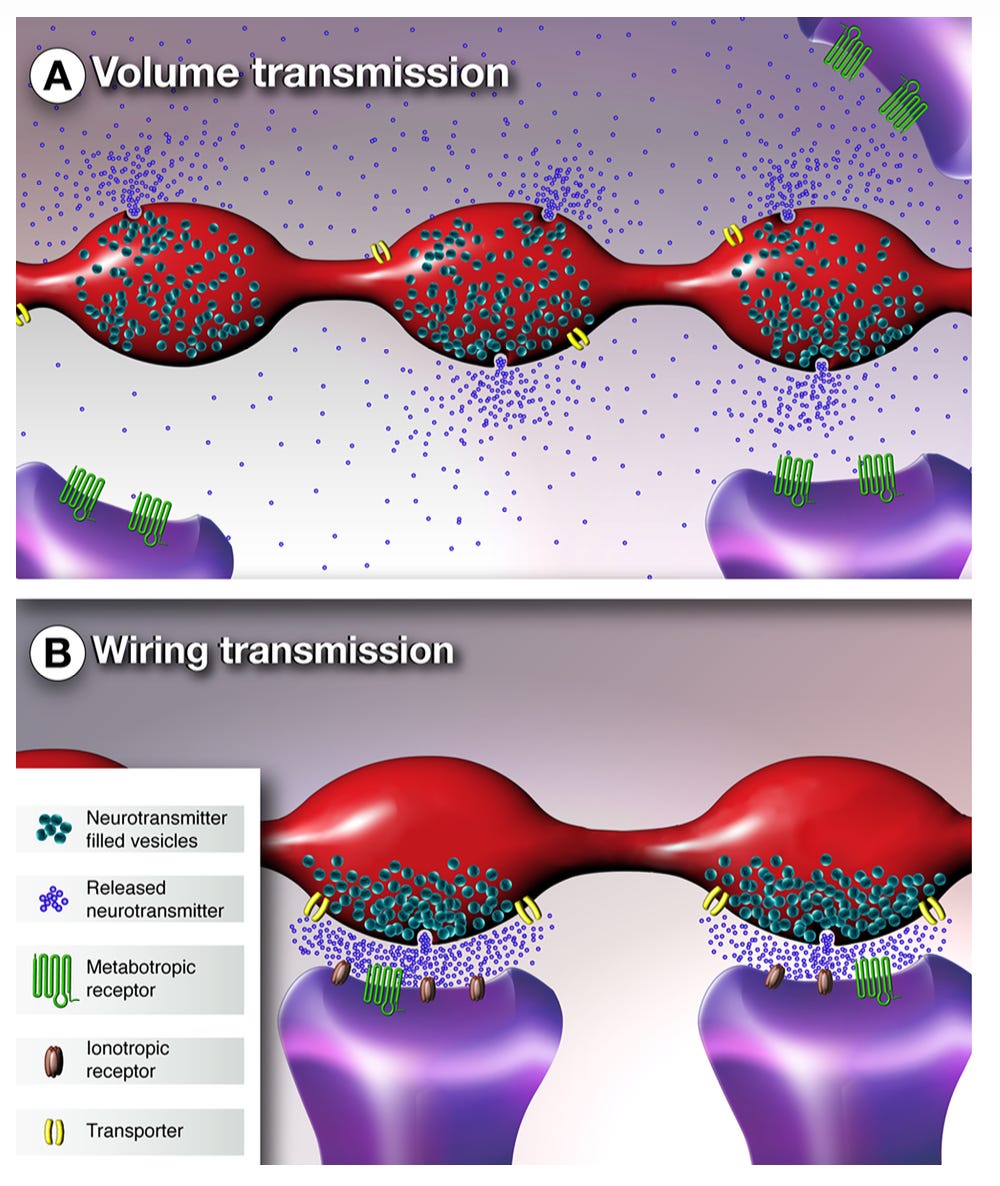
Fig 1: Illustration of volume vs. wiring (synaptic) transmission from (Gianni & Pasqualetti, 2023)
Recent work by Zhang et al. has challenged the assumption that volume transmission is the default (Zhang et al., 2025). They suggest synaptic or wiring communication may actually be the default mode during baseline “tonic” signaling (slow, continuous, steady), and that conversion to volume transmission is activity-dependent. During “phasic” activity (fast, brief, dynamic), released serotonin overwhelms the local reuptake machinery, spills out of the synapse, and converts these sites from one-to-one (synaptic) to one-to-many (volume) transmission—like switching from making a phone call to sending out a radio broadcast. When SERT is blocked with SRIs, the same switch to volume transmission occurs, and Zhang et al. demonstrated this experimentally.
So Zhang et al.’s work can be interpreted in two ways. If we accept their conclusion that synaptic communication is actually the default mode, then chronic SRI treatment converts the default mode of serotonergic signaling from targeted to broadcast — a wholesale qualitative shift, not just a quantitative increase in serotonin levels. More conservatively, their work shows that SRI treatment prevents the normal activity-dependent gating between synaptic and volume transmission at junctional sites, forcing them into constitutive volume transmission. These junctional sites comprise roughly 38% of serotonin release sites in the cortex (Séguéla, Watkins, & Descarries, 1989). On this more conservative interpretation, which I will operate from moving forward, SRI treatment compresses the system’s signaling repertoire: temporally, the contrast between tonic and phasic signaling is blurred; spatially, signaling shifts from targeted synaptic transmission toward more diffuse broadcast transmission. So I think talking about receptor adaptations alone doesn’t quite do it justice. Awais says that “neuroadaptation should be proportional to the degree of functional perturbation from baseline,” and here the system has undergone a fundamental shift in how it communicates—a huge functional perturbation that may be difficult to recover from.
There is an important counterpoint to the picture I’ve sketched. One proposed effect of SRIs is “frequency-dependent facilitation,” which involves amplified serotonin release as neuronal firing rate increases, and is often interpreted as enhanced phasic signaling (Dankoski, Carroll, & Wightman, 2016). The authors themselves suggested, however, that this effect may initially be masked by the large increase in ambient serotonin produced by SERT blockade, becoming more apparent as extracellular serotonin returns toward baseline with chronic treatment.
The problem with this is that extracellular levels don’t return to baseline—since that paper was published we’ve acquired clear evidence of significant serotonin elevations with chronic SRI treatment in most brain regions assessed, and this is generally considered necessary although not sufficient for their therapeutic effects (note this doesn’t necessitate that serotonin is “low” in depression; it instead suggests that raising serotonin in patients with normal levels can have therapeutic effects) (Fritze, Spanagel, & Noori, 2017). So by their own logic, sustained increases in serotonin would mask this effect.
That interpretation seems to fit the functional effects of SRIs better. In healthy volunteers, chronic SRI treatment reduces responsiveness to both rewarding and aversive stimuli and decreases reinforcement sensitivity, and these changes are associated with reduced anxiety (McCabe, Mishor, Cowen, & Harmer, 2010) (Langley et al., 2023), findings more consistent with dampened responsiveness to stimuli than with enhanced phasic reactivity. Phenomenologically, patients don’t describe being hyperattuned to stimuli; instead they often describe being less affected by thoughts or stimuli that previously provoked strong emotional responses. This can obviously be therapeutic, but it can also manifest as emotional blunting. Of note, the leading mechanistic explanation for emotional blunting from SRIs is that serotonin inhibits dopamine activity, indirectly inhibiting the salience network and prefrontal dopaminergic activity (Jawad et al., 2023). Tonic serotonin signaling inhibits dopamine activity while phasic serotonin signaling promotes it (De Deurwaerdère & Di Giovanni, 2017), so reducing phasic and increasing tonic activity may be an upstream mechanism leading to inhibited dopamine activity and emotional blunting.
So the same shift toward a more tonic and less differentiated serotonergic signal that could plausibly contribute both to some of the therapeutic effects of SRIs and to emotional blunting may also represent another substantial functional adaptation that the system must later reverse during withdrawal. If we think of SRI treatment as compressing the temporal dimension of serotonergic signaling—blurring the distinction between tonic background and phasic activity—then many withdrawal symptoms that are often mistaken for relapse or dismissed as nonspecific start to make more sense. As SRIs are withdrawn, the normal relationship between tonic background and phasic signaling may need to be re-established, and that process could itself be unstable. Phasic serotonin signaling broadly encodes salient environmental information, and has specifically been shown to respond to aversive stimuli (Schweimer & Ungless, 2010). Dysregulated phasic signaling could therefore plausibly contribute to the spontaneous panic or surges of severe anxiety patients often describe during withdrawal; I’ve often heard this described as an intense fear of something, without knowing what that something actually is.
What happens when SRIs are withdrawn
When SRIs are discontinued after years of use, I think it’s quite easy to imagine this system having trouble recalibrating back to its prior baseline. Prior work has proposed a “dual-phase” model of antidepressant withdrawal (Fig. 2), with an initial hyperserotonergic phase, and a subsequent hyposerotonergic state (Harvey & Slabbert, 2014). The initial phase involves rebound hyperexcitability. When the SRI is discontinued, extracellular serotonin levels quickly return toward baseline, but 5-HT1A autoreceptors remain desensitized, meaning they still require elevated serotonin to trigger any meaningful feedback inhibition on neuronal firing. Without that feedback, serotonergic firing is disinhibited and dysregulated (Harvey & Slabbert, 2014). This rebound hyperexcitability has been shown experimentally, and can be recapitulated using a 5-HT1A antagonist (Collins et al., 2024). You might think that buspirone, a 5-HT1A agonist, would help, but it has been reported to worsen acute withdrawal; it’s actually a partial agonist and acts both pre and postsynaptically, which complicates the picture. This phase may more cleanly map onto “acute” withdrawal symptoms, although in some patients these symptoms clearly extend into the protracted window.
This mechanism helps explain why short half-life SRIs are associated with more severe acute withdrawal symptoms. Drug levels drop quickly, and so do serotonin levels. So the system spends more time in a state where serotonin levels are insufficient to restrain dysregulated neuronal firing, and the faster rate of decline in serotonin likely increases the severity of this dysregulated firing.
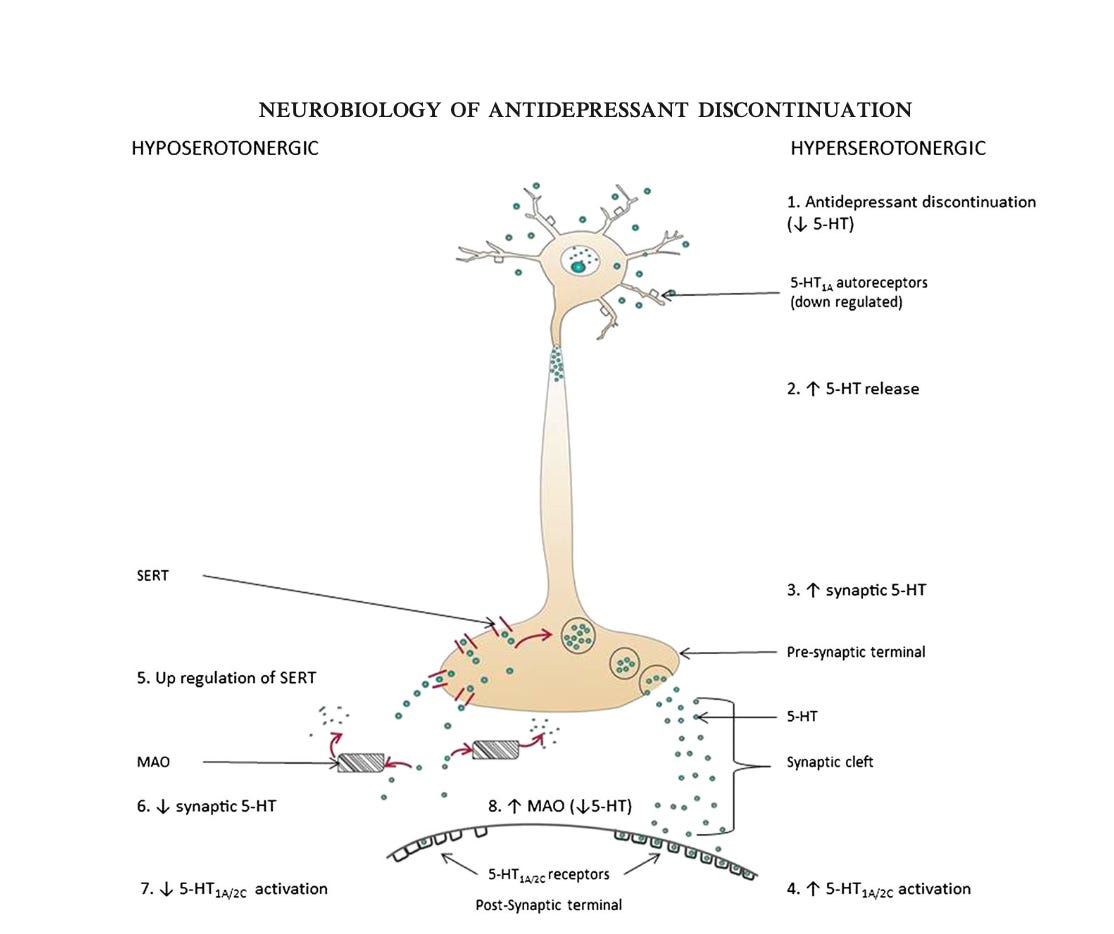
Fig. 2: Hyperserotonergic and hyposerotonergic withdrawal symptoms, from (Harvey & Slabbert, 2014)
Harvey and Slabbert frame the subsequent phase as a transition to a functionally hyposerotonergic state, where autoreceptor function has normalized, but the extracellular serotonin levels that were previously sufficient pre-treatment are now insufficient to stimulate chronically downregulated serotonin receptors. This dual-phase framing offers a simple explanation for some cases of delayed-onset withdrawal: a patient may not experience the classic hyperserotonergic acute withdrawal symptoms initially, but develop hyposerotonergic symptoms weeks to months later as SERT re-expression slowly occurs, serotonin drops further, and receptors are increasingly understimulated.
So, there is a potentially extended window where the “hyperserotonergic” symptoms have resolved, but where “hyposerotonergic” symptoms emerge as downregulated receptors receive inadequate signal. But as we’ve seen, it’s not just the same receptors getting less stimulated; the zone of extracellular serotonin diffusion is shrinking back towards baseline as the SRI is tapered, so a given varicosity is now reaching fewer downstream receptors. The system is trying to navigate back through the qualitative shift in signaling that occurred with chronic treatment, which may be a genuinely difficult problem to solve. In some patients, it may simply not be able to self-correct to its prior baseline over any reasonable time frame, yielding protracted withdrawal.
Comparing the serotonin system with the dopamine systems
Although the serotonin and dopamine systems are different in many important ways, they are both fundamentally monoamine systems, and we can draw useful inferences by looking at drugs targeting the dopamine system. The most obvious comparison would be dopamine-transporter (DAT) inhibitors, but available DAT-blocking drugs either have important additional mechanisms or produce relatively transient transporter occupancy, making them a poor analogue for the sustained SERT blockade produced by chronic SRIs.
A more useful comparison can be made between SRIs and dopamine agonists; the two share many surprising similarities. Used to treat Parkinson’s disease, they cause sustained, unvarying agonism of dopamine receptors, and this sustained agonism also appears to trigger D2 autoreceptor desensitization, although this is less robust than for the 5-HT1A autoreceptor (Voon et al., 2017). Dopamine agonist withdrawal syndrome, or DAWS, shares striking similarities with SRI withdrawal. It has many symptoms which overlap heavily with both stimulant and SRI withdrawal: anxiety, panic attacks, dysphoria, depression, agitation, irritability, fatigue, suicidal ideation, orthostatic hypotension, nausea, vomiting, and diaphoresis (Nirenberg, 2013). However, these patients were obviously put on dopamine agonists for Parkinson’s, not mood or anxiety disorders, so in general these symptoms can’t be easily misattributed to relapse, as they often are in SRI withdrawal. A hallmark of DAWS is that it may be protracted, lasting for months to years in some cases, and onset is variable (Nirenberg, 2013).
The automatic response to this may be that drug withdrawal is simply unmasking a hypodopaminergic state caused by their underlying Parkinson’s; they’ve been on dopamine agonists for years which masked their symptoms until drug removal. However, DAWS doesn’t respond to any other forms of dopaminergic therapy, including levodopa, and risk tracks with total agonist dose rather than disease severity—all of which suggests that it represents a true withdrawal syndrome. DAWS patients aren’t just suffering from a generic hypodopaminergic state; they’re withdrawing from the specific, unnatural pattern of unvarying tonic stimulation induced by dopamine agonists. Reinstating with a dopamine agonist is the only thing that resolves symptoms, but this sometimes induces impulse control disorders at very low doses, suggesting sensitization and persistent dysregulation (Nirenberg, 2013).
In contrast, levodopa is converted to dopamine via presynaptic machinery and relies, at least in part, on endogenous synthesis, storage, and activity-dependent release, thereby preserving more of the dynamic range of native dopaminergic signaling than dopamine agonists, particularly early in the disease course. As Parkinson’s progresses and endogenous dopamine dynamics are degraded, levodopa yields an increasingly pulsatile pattern of stimulation in line with its dosing pattern, which seems to increase dyskinesia risk during treatment relative to dopamine agonists. However, levodopa lacks a classic drug-specific withdrawal syndrome, and the severity of withdrawal-emergent symptoms tracks disease progression, suggesting drug withdrawal unmasks underlying nigrostriatal degeneration rather than causing a dependence-driven rebound as seen in DAWS (Riederer et al., 2025). This is not to say that withdrawing levodopa doesn’t present issues: it can trigger Parkinsonism-Hyperpyrexia Syndrome (PHS), which can be life-threatening. However, PHS can also be triggered by dopamine agonist withdrawal, and this syndrome responds to any dopaminergic agent, in stark contrast to DAWS—both of which suggest PHS is the consequence of an acutely induced, generic hypodopaminergic state rather than a drug-specific withdrawal syndrome. The contrast suggests that protracted withdrawal risk may depend not simply on how much signaling is elevated, but on how strongly treatment distorts the native signaling pattern. In the case of both SRIs and dopamine agonists, that distortion may involve pushing the system towards a more tonic, unvarying signal over time. In contrast, the more pulsatile distortions produced by levodopa cause issues related to treatment itself, but don’t appear to generate the same protracted withdrawal risk.
So dopamine agonists and SRIs induce similar qualitative shifts. SERT blockade shifts signaling toward volume transmission, degrading an important source of temporal information normally conveyed by the transition from synaptic to volume transmission during high-frequency bursts, while also reducing the spatial specificity provided by synaptically confined signaling. Similarly, dopamine agonists reduce the activity of phasic burst neurons, and continuous agonism of dopamine receptors enhances tonic tone (Voon et al., 2017). In both cases, the signaling repertoire becomes compressed: the system becomes louder, but less informative. It’s like someone with a loudspeaker with only one message, and the system adapts to this unvarying input. Just as someone with OCD who avoids targeted exposures becomes less tolerant of them by way of adaptation, a system becomes less tolerant of perturbations when it sees an unvarying, elevated signal—rendering it vulnerable to perturbations like withdrawal.
A reasonable objection to this may be that tonic elevations cause receptor desensitization broadly; doesn’t that make the system less sensitive to perturbations? Not quite: this conflates the system’s gain (how much output a given input produces) and regulatory capacity (how well the system corrects a displacement). Desensitization lowers the system’s gain, meaning a greater input is required for the same output. But this just means the operating set point has been increased, and tonic, unvarying input could render the system more dependent on that input for stability, representing a loss of regulatory capacity.
One framework that may be useful here is adaptive homeostasis, which states that biological systems contract their homeostatic range in response to unvarying signals (Davies, 2016). In general, biological systems require exposure to normal variation in their inputs to maintain the machinery that handles perturbation. When variation is removed, adaptive machinery is downregulated to conserve energy—basically “use it or lose it.” For example, muscle without load no longer maintains its neuromuscular junctions, and cells without intermittent stress scale back their protective networks. The system seems to operate normally while the environment stays constant, but struggles once conditions change and the adaptive mechanisms are called upon.
All of this, I hope, paints a picture of how profound the functional perturbations are with chronic SRI treatment. The system has been chronically operating with a compressed signaling repertoire—a profoundly altered, relatively flat mode of communication—and the path back to baseline may be genuinely difficult to navigate. What I find remarkable, actually, is that in most cases it does find its way back.
A dynamical systems perspective
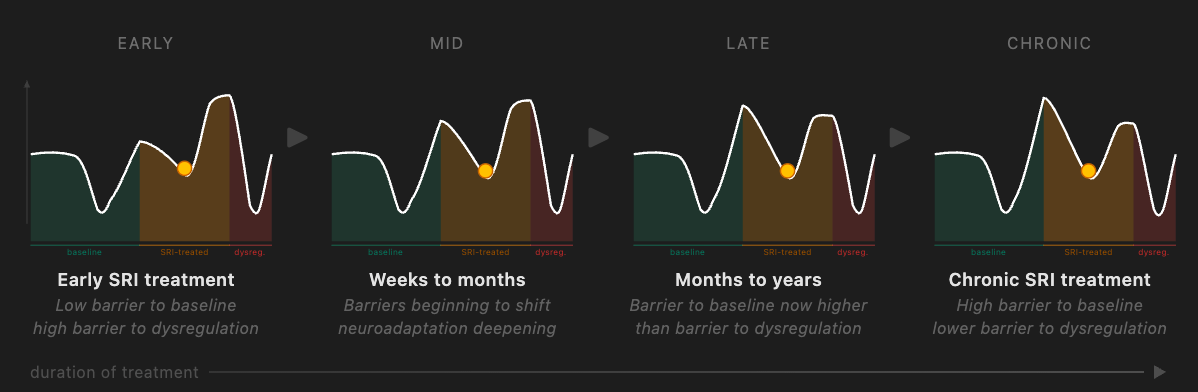
Dynamical systems theory provides a useful framework for conceptualizing this problem. On this view, a system sits in an attractor basin — a stable state it returns to after being nudged — and the stability of that state to perturbations is denoted by its depth. The system can be pushed into less or more optimal attractor states by perturbations sufficient to push the system out of its current attractor basin. The landscape also isn’t fixed: as underlying conditions shift, barriers to alternative states can decrease or increase, raising or lowering the probability of the system being pushed into one.
The most recognized invocation of dynamical systems theory in psychiatry recently has probably been Carhart-Harris’s application to mental disorders, where certain disorders represent the brain becoming trapped in a deep attractor (Carhart-Harris et al., 2023), and where psychedelics induce “annealing,” figuratively heating the system and making it more plastic, ideally to facilitate transitions to more optimal states (Carhart-Harris & Friston, 2019). Of more direct relevance, Yano et al. have applied dynamical systems theory to the serotonergic system itself, modeling the reciprocal feedback between extracellular serotonin and autoreceptor regulation. Their model showed that changes in the properties of this feedback system can produce a bifurcation from a single, healthy stable state into a bistable regime with a new pathological attractor; each stable state is associated with different levels of autoreceptor expression and extracellular serotonin. Once such bistability emerges, subsequent perturbations can push the system from one stable configuration into another, where it may remain even after the original perturbation has passed (Yano, Watanabe, Aonuma, & Asama, 2013). Although their model was not designed to explain antidepressant withdrawal, it provides a useful proof of principle: if chronic treatment and withdrawal alter the regulatory architecture of the serotonin system enough to induce multistability, dysregulation of autoreceptor function or acute shifts in extracellular serotonin—both of which may occur during withdrawal—could push the system into a self-sustaining dysregulated state.
With all of this in hand, we can paint a picture of what the progression both to and from the SRI-treated state may look like for the serotonin system from a dynamical systems perspective. Doing so helps us conceptualize both delayed-onset withdrawal and withdrawal that doesn’t respond to drug reinstatement.
One disclaimer—the landscapes below are conceptual stability landscapes rather than calculated energy landscapes: valley depth and barrier height represent the relative stability of a state and its resistance to perturbation, not literal physical energy.
In the model I’m proposing, early on in SRI treatment, the energy barrier between the treated and untreated state is low, making the transitions between each state relatively easy. As time progresses, the system becomes adapted to the tonic, steady elevation in serotonin and becomes both less tolerant of perturbations, and more estranged from the healthy baseline state. These are represented as the energy barrier between the SRI-treated and the dysregulated state progressively decreasing, and the barrier between the SRI-treated and healthy baseline state progressively increasing, respectively.
The process of tapering from the chronically treated state can be represented by another remodeling of the landscape. When done carefully, the barrier back to baseline slowly decreases, and the system eventually returns there as the landscape remodels. However, a sufficiently large perturbation, like a too large dose reduction, can push the system across the boundary of its current attractor and into a dysregulated state like acute withdrawal.
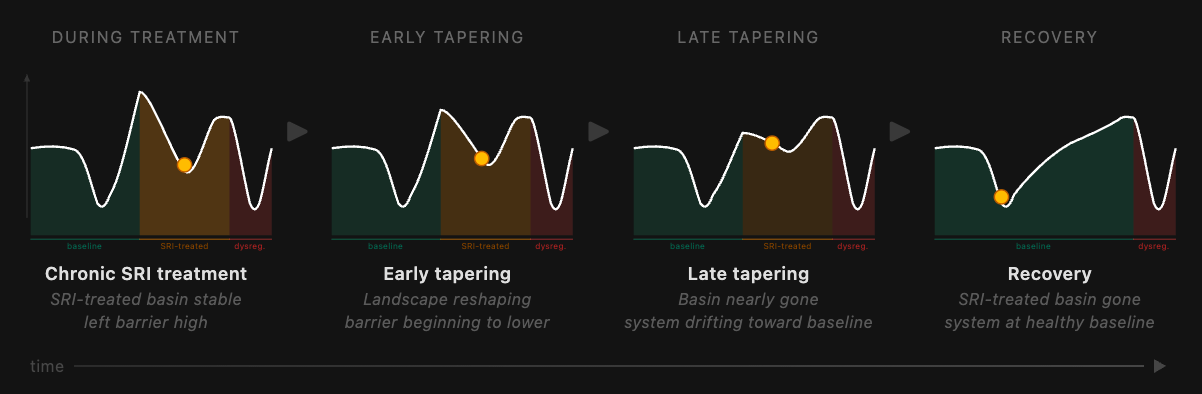
In a patient with underlying vulnerabilities, or if a taper is done too quickly, the remodeling process may not necessarily push the system back towards baseline over time; rather than the barrier towards baseline decreasing, the barrier towards a dysregulated state may instead decrease, and eventually the system settles there rather than back towards baseline. Notice that the system is functionally in the SRI-treated state until the remodeling is complete, so the patient may be largely asymptomatic during this process. This may be one way to conceptualize how delayed-onset withdrawal occurs.
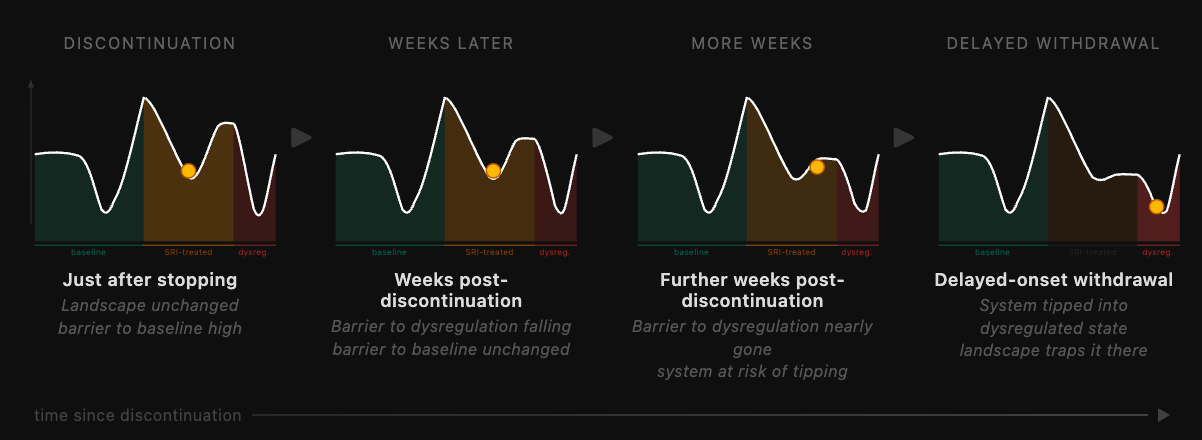
One possibility, then, is that delayed-onset withdrawal reflects an aberrant remodeling process, while acute withdrawal may more often be the consequence of a too-large perturbation that pushes the system into dysregulation.
Patient reports also suggest that some people who ultimately develop protracted withdrawal first spend an extended period in acute withdrawal without reinstating. This suggests to me that protracted withdrawal may also be the consequence of aberrant remodeling. So the stress of continued withdrawal lowers the barrier towards a protracted state over time, and the system settles there. Notice that the height of the barrier back to the treated state is larger than it was when in the acute withdrawal state, so even if the perturbation of reinstatement was sufficient to restore the system back to the treated state when in acute withdrawal, that doesn’t necessarily mean it’s sufficient in the case of protracted withdrawal.
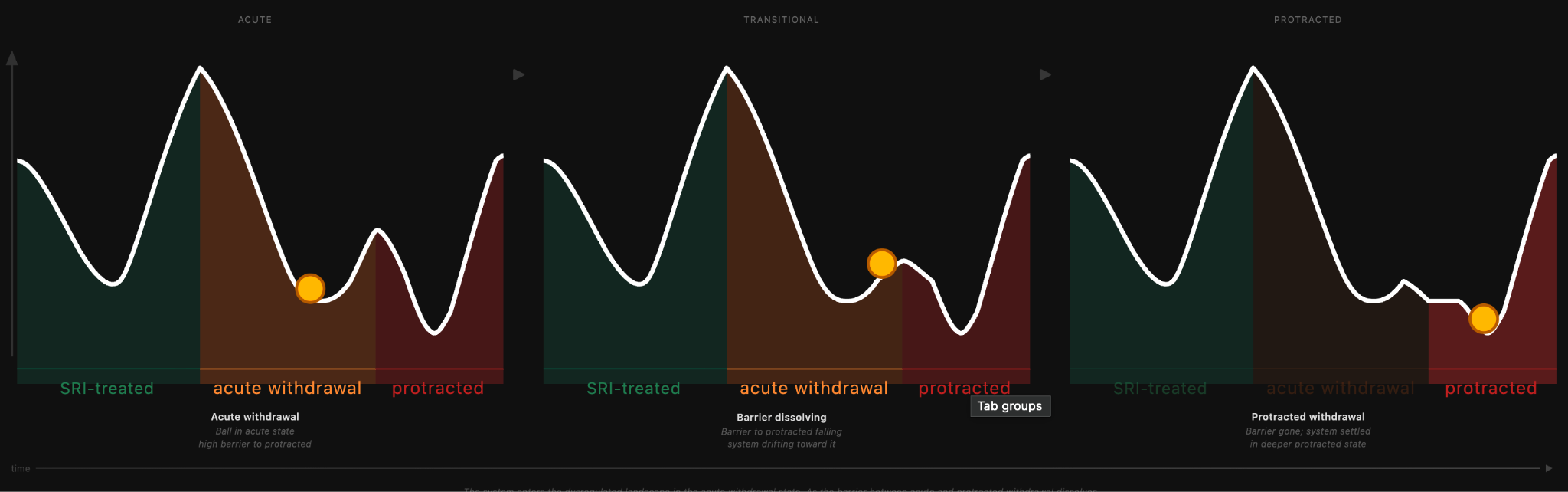
Dynamical systems models have shown that the speed at which conditions change can affect not just where a system is pushed to, but how its stability landscape evolves. When different parts of a system respond on different timescales, rapid change can produce a different pattern of shifting attractors and barriers than the same change occurring gradually (Kaszás, Feudel, & Tél, 2019) (Feudel, 2023). So if SERT inhibition falls faster than autoreceptors, transporter expression, receptor signaling, and other processes can recalibrate, that mismatch could send the serotonin system down a different path of readaptation, potentially lowering the barrier toward a dysregulated state rather than progressively restoring the landscape toward its pre-treatment configuration.
Of course, this framing is not a quantitative model of antidepressant withdrawal. Formal dynamical systems models generally use equations that specify how different components of a system interact and change over time, and we are nowhere near having that level of mechanistic precision for antidepressant withdrawal. But this framework can still be quite useful. Scheffer and colleagues have applied this framework to psychiatric disorders broadly, and stated explicitly that even when the relevant causal relationships cannot yet be quantified, dynamical systems theory can still provide a useful qualitative framework for understanding how complex systems change over time (Scheffer et al., 2024). I’m using it in that spirit here—not as proof that withdrawal behaves exactly this way, but as a conceptual model that I think captures the problem more richly than simply thinking in terms of “serotonin + receptors.”
Does any of this support hyperbolic tapering?
Awais initially raised the challenge that even if the mechanistic picture I’ve sketched is correct, it doesn’t automatically follow that hyperbolic tapering is the right clinical response. He suggested that hyperbolic tapering requires desensitization to be at least partially reversible on taper-relevant timescales, and if it is reversible on those timescales, it is not persistent for months to years after discontinuation. So on my account, if these adaptations can persist for months to years after the drug is gone, then what is a hyperbolic taper with small steps every 2-4 weeks supposed to do?
My answer is that yes, some re-adaptations are happening at each taper step, but it’s less about the system fully re-adapting at each step, and more about 1) staying within a window of tolerability and 2) promoting healthy re-adaptations. I think there are many layers of adaptations of varying time scales, and hyperbolic tapering allows time for these differing scales. As illustrated by the dynamical systems framing, I think hyperbolic tapering both reduces risk of the system being pushed into a dysregulated state by a too-large perturbation, and allows the system to navigate this complex process of re-adapting back to baseline more carefully, leading to more appropriate landscape remodeling. Because the system has received a tonically elevated signal that is less differentiated in both time and space for years, it has become tuned for that more unvarying input and less tolerant of perturbations. Hyperbolic tapering keeps those perturbations within a tolerable window as the system (hopefully) slowly recovers.
In the most canonical form of R-tipping, the landscape doesn’t necessarily deform at all: it can retain its shape while moving along a given axis. If the landscape moves slowly enough, the system (the ball in the valley) can track its moving attractor while remaining within its basin. If it moves too quickly, the system may lag behind, cross a basin boundary, and enter an alternative state such as withdrawal. It’s a bit like a pickup truck accelerating so quickly that cargo in the bed gets left behind. This illustrates a second possibility alongside the aberrant remodeling described earlier: a rapid fall in SERT inhibition could lead to aberrant remodeling, or leave its shape intact but move it too quickly for the system to keep up.
So with the richer conceptual framework dynamical systems theory provides, we can imagine several ways in which hyperbolic tapering is helpful without the system necessarily needing to completely re-adapt at each taper step. Smaller dose reductions may prevent a single perturbation from pushing the system across an energy barrier into a dysregulated state. Allowing more time for adaptations operating on different timescales may promote landscape remodeling toward the pretreatment state rather than toward a dysregulated one. And a slower overall rate may reduce the risk of losing track of a moving attractor, as in canonical R-tipping.
Lack of controlled studies on hyperbolic tapering
There aren’t any controlled studies on hyperbolic tapering, which is a significant limitation, but I think the reason deserves emphasis. There’s historically been essentially no funding for this research. So even if hyperbolic tapering were perfectly effective, we still wouldn’t have satisfying evidence for it. Anytime we discuss iatrogenic harms, the institutional context around the research, or the lack of it, needs to be part of the conversation. Nonetheless, there have been some observational studies using hyperbolic tapering (Groot & van Os, 2021), and two RCTs have now been initiated — RELEASE and DISCARD — though DISCARD’s maximum duration of 4-5 months raises the question of whether tapers of that length will be adequate for the most sensitive patients, potentially creating a floor effect that obscures a real signal.
That said, I think the uptake and clinical impact of the Maudsley Deprescribing Guidelines tells us something. And it’s worth noting that patients effectively discovered proportional tapering on their own, well before the research on hyperbolic occupancy curves was widely published. In the absence of appropriate institutional guidance, they empirically arrived at 10% monthly reductions through trial and error. So although some have said that hyperbolic tapering is mediated largely by expectancy effects, patients developed the need for proportional tapering before they had any scientific framework to form expectations around. The fact that our mechanistic understanding now converges with what they found empirically both validates their experience and lends credibility to the underlying biology.
Also, if only a small proportion of patients are sensitive enough to require very slow hyperbolic tapers, a study enrolling all patients who taper will need to be very large to detect a difference. Enriching enrollment for high-risk patients would make picking up a signal considerably easier.
The asymmetry between going up and going down
The dynamical systems framing makes clear that the path back to baseline is different from the path to the SRI-treated state: the landscape has been altered by chronic treatment. One form of this path-dependence is termed hysteresis, where the route back through a system differs from the route in (Angeli, Ferrell, & Sontag, 2004). It has been shown at the level of brain networks—concentration thresholds of anesthetics used to remove consciousness are not the same as those needed to restore it (Kim, Moon, Mashour, & Lee, 2018)—and Fava’s oppositional tolerance concept, which Awais discussed in his piece, describes treatment course in hysteresis-like terms.
This path-dependence helps explain an asymmetry Awais raises: we jump a drug-naive brain from 0% to 70-80% SERT occupancy in a matter of weeks when starting an SRI, and the brain adapts without anyone proposing a hyperbolic uptitration schedule. Yet, the hyperbolic framework implies that comparable dose reductions on the way down are dangerously large perturbations. The answer here is essentially hysteresis: the path down the occupancy curve after years of treatment is fundamentally different from the path up during initial uptitration. On the way up, the serotonergic system is drug-naive: it hasn’t yet undergone the transmission mode shift, the autoreceptor desensitization, or the compression of its signaling repertoire described above. On the way down, it has, and these changes have rendered the system less tolerant of perturbations.
Awais initially argued that if 70-80% SERT occupancy is required for a clinically meaningful antidepressant effect, the system must have substantial buffering capacity — and that neuroadaptation at subtherapeutic occupancy should therefore be minimal. He’s since agreed that this conflates two different sensitivities: the sensitivity of the mood-relevant clinical output and the sensitivity of the homeostatic machinery, which need not share a threshold. In other words, the therapeutic threshold tells us something about the system’s functional sensitivity for therapeutic effects, not for any effects. 70-80% occupancy may be required for antidepressant effects, but lower occupancies may be sufficient to induce significant neuroadaptation. It’s very plausible that a dose may be insufficient to modulate mood/anxiety or really have meaningful subjective effects on the “way up” or with treatment, but induce significant withdrawal symptoms on the way down—this is true anecdotally for many patients. And since anyone who has been on an SRI has generally been on therapeutic doses, they’ve experienced 70-80%+ occupancy and all of the neuroadaptations detailed above. So although neuroadaptation can absolutely occur at lower occupancies, the clinically relevant question is almost always about returning from therapeutic occupancies—and all that has to be true is that some patients genuinely struggle to reverse the deep neuroadaptations induced by long-term therapeutic dosing.
Beyond occupancy
All of this suggests that SERT occupancy alone is an inadequate map of what’s actually happening during tapering. Awais makes this point too: withdrawal symptoms are downstream consequences of receptor adaptations, second-messenger changes, gene expression shifts, and network-level changes, and the relationship between an occupancy change and those downstream effects need not follow the same curve as occupancy itself; in other words, the relationship between occupancy and clinical effects may be nonlinear. I completely agree. In fact, Bryan Shapiro and I recently submitted a paper modeling extracellular serotonin levels that shows the relationship between SERT occupancy and serotonin is itself nonlinear — technically hyperbolic (preprint here). So even before receptor and network adaptations enter the picture, SERT occupancy is already translated nonlinearly into extracellular serotonin.
The motivation was trying to explain why withdrawal occurs within the therapeutic dose range. If occupancy were the whole story, the fact that it’s nearly flat in the therapeutic range (Fig. 4) would suggest withdrawal shouldn’t really happen there, but it clearly does in some patients. In short, the same law of mass action that causes dose-occupancy curves to plateau also causes extracellular serotonin to rise significantly throughout the therapeutic dose range. It’s far from a complete model of biological effects, but it is a necessary step toward modeling further downstream nonlinear dynamics and individual variations in things like autoreceptor function and SERT/MAO activity. It also ties in nicely with Zhang et al.’s work: the degree of serotonin elevation correlates with the degree of shift to volume transmission, so tapering an SRI involves a transition from more volume transmission back toward synaptic transmission at synaptic sites, and the speed of the taper may influence how smoothly the system can negotiate that transition.
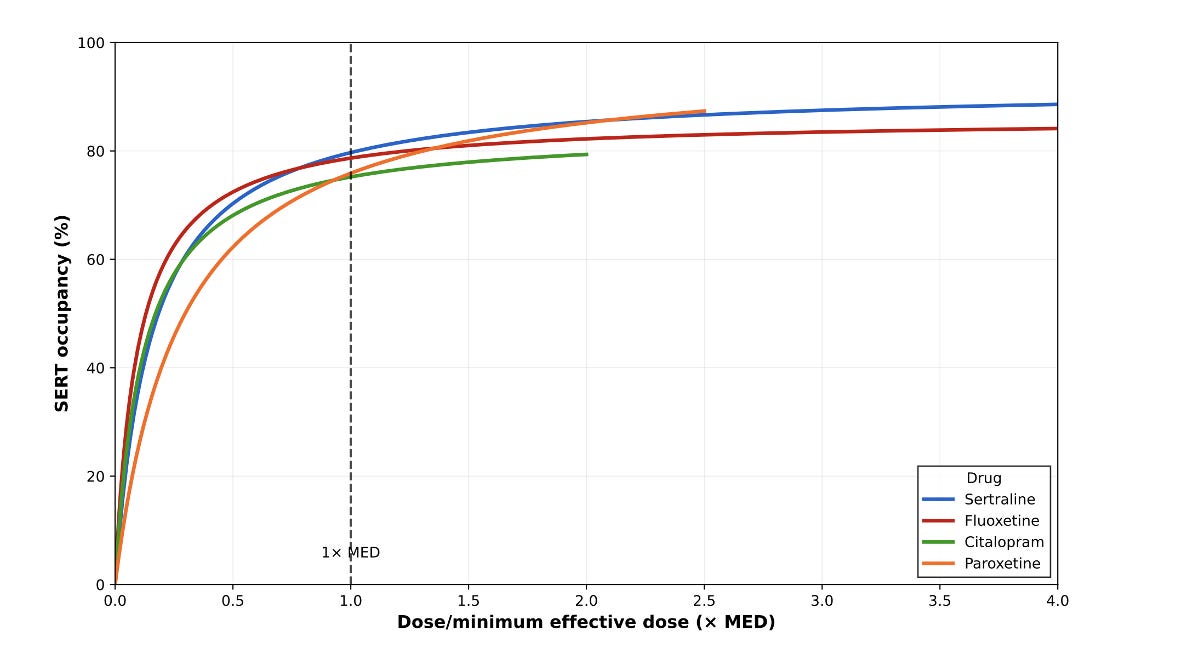
Fig. 4: Dose-occupancy curves for SSRI antidepressants, normalized to the U.S. Food and Drug Administration (FDA) minimum effective dose for the treatment of major depressive disorder (Sørensen, Ruhé, & Munkholm, 2022). Curves are truncated at the F.D.A. maximum recommended doses.
I’ve heard withdrawal in this flat occupancy range attributed to psychological factors. This paper is a good example of why that’s exactly the wrong assumption — a plausible biological mechanism was just around the corner, and that kind of thinking only inhibits proper investigation.
It’s also worth noting that while the focus so far has been on the brain, serotonin receptors are expressed in nearly every peripheral organ (the gut, vasculature, immune cells, adrenal glands, etc.), and the effect of SRIs on local serotonin levels is very context-dependent and hard to predict. So some withdrawal symptoms might be related to changes in peripheral, rather than central, serotonin levels.
Comorbid and overlapping conditions
As with any psychiatric population, some patients will inevitably have FND, ME/CFS, or similar conditions. However, patients with more complex medical histories are probably more prone to withdrawal in the first place, so there’s a selection bias at work. Some will have withdrawal overlaid on prior pathologies, while others may have withdrawal that triggered or worsened an underlying vulnerability. Proving that withdrawal didn’t at least contribute to a given presentation will often be difficult, which cuts both ways: we shouldn’t too quickly attribute protracted symptoms to these conditions, any more than we should too quickly attribute them to withdrawal alone.
The conditions that I think will likely have the most overlap with protracted withdrawal and really need to be considered are central sensitization and nociplastic pain, conditions classically associated with chronic pain. My research partner Bryan Shapiro has explored this question in depth in a recent Substack article, making a compelling case for the overlap between protracted withdrawal and central sensitization. I think he’s identified something genuinely important, although I’d frame central sensitization and nociplastic pain as potential comorbidities rather than as alternative explanations for what protracted withdrawal is. It’s worth emphasizing that central sensitization is not a psychological phenomenon; it is a specific biological pathway in which intense or sustained nociceptive input produces hyperexcitability of central nociceptive neurons, making them respond excessively to normal or subthreshold input.
Nociplastic pain is a broader syndrome that includes central sensitization as an important mechanism but also involves top-down amplification and decreased inhibition of pain processing at multiple levels of the nervous system, ultimately manifesting as general CNS hyperexcitability. The difficulty is that serotonin itself regulates pain processing, autonomic function, arousal, immune signaling, and many of the pathways implicated in nociplastic pain. So the dysregulated serotonergic dynamics that may be present in withdrawal mean the overlap between withdrawal and nociplastic pain may be mechanistic, not just symptomatic. This means that treatments used for nociplastic pain could potentially help some patients with protracted withdrawal. However, we need to be cautious not to conclude that patients who benefit from such treatments must actually have nociplastic pain and not protracted withdrawal: the mechanistic overlap means these approaches may genuinely help without telling us anything definitive about the underlying diagnosis. And the fact that SRI withdrawal and many of these other conditions share some nonspecific symptoms doesn’t itself necessarily point to a shared underlying etiology.
My own experience with protracted withdrawal
Like many who study antidepressant withdrawal, I have lived experience with it. In my case it is mirtazapine, which I have experienced protracted withdrawal from for extended periods—certainly well over a year—multiple times throughout the past 10 years, with numerous failed tapers. I have developed an incredible array of non-psychiatric health issues related to tapering, even when done at an extremely slow rate. Dose reductions of well under 1 mg reliably trigger profound gastrointestinal issues. I do have underlying gastrointestinal issues, but the mirtazapine taper magnifies these exponentially. Most recently, repeated attempts at microtapering have reliably triggered biliary hyperkinesia (confirmed via HIDA scan) and associated bile reflux that caused gastritis with bleeding significant enough to leave me iron-deficient.
Initially, I blindly put faith in the idea that my body would eventually adapt, and I largely held at the same dose for over 1 year, with no improvement in symptoms. Other symptoms come along with withdrawal: extreme night sweats, dyshidrotic eczema and other atopic issues, insomnia—none of which were issues I had pre-treatment. Upon reinstatement, these issues usually vanish within a few doses, although I have been through periods of protracted instability as well. Notably, these dose changes produce little change in my underlying anxiety or mood; the withdrawal phenomena are overwhelmingly physical. Mirtazapine is an extremely potent H1 blocker, and replacing that activity with a peripherally (not centrally, so no effects on anxiety) acting potent antihistamine like desloratadine mitigates the GI and allergic symptoms. But, mirtazapine being such a “dirty” drug, i.e. hitting so many diverse receptors, makes simply replacing its activity to facilitate tapering somewhat complicated—ending up on a slew of new drugs in order to get off of this one isn’t a great solution. I should mention that mirtazapine is an atypical antidepressant, not an SRI, so the specific mechanistic arguments I’ve laid out regarding SRIs previously don’t apply directly to mirtazapine. However, the broader principles do: drugs that render the system more rigid and intolerant of perturbations increase withdrawal risk, and I believe mirtazapine does so through analogous mechanisms.
I know that my case is an extreme outlier, even amongst those with mirtazapine withdrawal. However, my experience has shown me that protracted symptoms related to psychotropic withdrawal are absolutely possible, and can be genuinely biological without needing to appeal to psychosomatic or psychological explanations. Unfortunately, the research is too limited to tell us definitively how common cases like mine are. Although most cases of protracted withdrawal do seem to eventually improve over time, both my experience and my research have taught me that the body and brain can fundamentally become dysregulated by chronic psychotropic treatment, and in some cases it simply cannot independently recover to a pre-treatment baseline over time scales we normally associate with withdrawal.
Disclosure: I serve as a consultant to Outro Health, a company focused on antidepressant deprescribing. This essay was conceived and substantially developed prior to the start of my work with Outro, and the views expressed here are my own.
Comments are open.
Psychiatry at the Margins is a reader-supported publication. Subscribe here.
Bibliography
Angeli, D., Ferrell, J. E., & Sontag, E. D. (2004). Detection of multistability, bifurcations, and hysteresis in a large class of biological positive-feedback systems. Proceedings of the National Academy of Sciences of the United States of America, 101(7), 1822–1827.
Bahji, A., Crockford, D., & El-Guebaly, N. (2022). Neurobiology and Symptomatology of Post-Acute Alcohol Withdrawal: A Mixed-Studies Systematic Review. Journal of Studies on Alcohol and Drugs, 83(4), 461–469.
Carhart-Harris, R. L., Chandaria, S., Erritzoe, D. E., Gazzaley, A., Girn, M., Kettner, H., Mediano, P. A. M., et al. (2023). Canalization and plasticity in psychopathology. Neuropharmacology, 226, 109398.
Carhart-Harris, R. L., & Friston, K. J. (2019). REBUS and the anarchic brain: toward a unified model of the brain action of psychedelics. Pharmacological Reviews, 71(3), 316–344.
Collins, H. M., Gullino, L. S., Ozdemir, D., Lazarenco, C., Sudarikova, Y., Daly, E., Pilar Cuéllar, F., et al. (2024). Rebound activation of 5-HT neurons following SSRI discontinuation. Neuropsychopharmacology, 49(10), 1580–1589.
Dankoski, E. C., Carroll, S., & Wightman, R. M. (2016). Acute selective serotonin reuptake inhibitors regulate the dorsal raphe nucleus causing amplification of terminal serotonin release. Journal of Neurochemistry, 136(6), 1131–1141.
Davies, K. J. A. (2016). Adaptive homeostasis. Molecular aspects of medicine, 49, 1–7.
Feudel, U. (2023). Rate-induced tipping in ecosystems and climate: the role of unstable states, basin boundaries and transient dynamics. Nonlinear processes in geophysics, 30(4), 481–502.
Gianni, G., & Pasqualetti, M. (2023). Wiring and volume transmission: an overview of the dual modality for serotonin neurotransmission. ACS Chemical Neuroscience, 14(23), 4093–4104.
Groot, P. C., & van Os, J. (2021). Successful use of tapering strips for hyperbolic reduction of antidepressant dose: a cohort study. Therapeutic advances in psychopharmacology, 11, 20451253211039330.
Harvey, B. H., & Slabbert, F. N. (2014). New insights on the antidepressant discontinuation syndrome. Human Psychopharmacology, 29(6), 503–516.
Hengartner, M. P., Schulthess, L., Sorensen, A., & Framer, A. (2020). Protracted withdrawal syndrome after stopping antidepressants: a descriptive quantitative analysis of consumer narratives from a large internet forum. Therapeutic advances in psychopharmacology, 10, 2045125320980573.
Horowitz, M. A., Framer, A., Hengartner, M. P., Sørensen, A., & Taylor, D. (2023). Estimating Risk of Antidepressant Withdrawal from a Review of Published Data. CNS Drugs, 37(2), 143–157.
Kaszás, B., Feudel, U., & Tél, T. (2019). Tipping phenomena in typical dynamical systems subjected to parameter drift. Scientific Reports, 9(1), 8654.
Kim, H., Moon, J.-Y., Mashour, G. A., & Lee, U. (2018). Mechanisms of hysteresis in human brain networks during transitions of consciousness and unconsciousness: Theoretical principles and empirical evidence. PLoS Computational Biology, 14(8), e1006424.
Langley, C., Armand, S., Luo, Q., Savulich, G., Segerberg, T., Søndergaard, A., Pedersen, E. B., et al. (2023). Chronic escitalopram in healthy volunteers has specific effects on reinforcement sensitivity: a double-blind, placebo-controlled semi-randomised study. Neuropsychopharmacology, 48(4), 664–670.
Marty, V. N., & Spigelman, I. (2012). Effects of alcohol on the membrane excitability and synaptic transmission of medium spiny neurons in the nucleus accumbens. Alcohol (Fayetteville, N.Y.), 46(4), 317–327.
McCabe, C., Mishor, Z., Cowen, P. J., & Harmer, C. J. (2010). Diminished neural processing of aversive and rewarding stimuli during selective serotonin reuptake inhibitor treatment. Biological Psychiatry, 67(5), 439–445.
Metts, A. V., Rubin-Falcone, H., Ogden, R. T., Lin, X., Wilner, D. E., Burke, A. K., Sublette, M. E., et al. (2019). Antidepressant medication exposure and 5-HT1A autoreceptor binding in major depressive disorder. Synapse, 73(6), e22089.
Nirenberg, M. J. (2013). Dopamine agonist withdrawal syndrome: implications for patient care. Drugs & Aging, 30(8), 587–592.
Paquelet, G. E., Carrion, K., Lacefield, C. O., Zhou, P., Hen, R., & Miller, B. R. (2022). Single-cell activity and network properties of dorsal raphe nucleus serotonin neurons during emotionally salient behaviors. Neuron, 110(16), 2664-2679.e8.
Quinn, R. (2005). Comparing rat’s to human’s age: how old is my rat in people years? Nutrition, 21(6), 775–777.
Raap, D. K., Garcia, F., Muma, N. A., Wolf, W. A., Battaglia, G., & van de Kar, L. D. (1999). Sustained desensitization of hypothalamic 5-Hydroxytryptamine1A receptors after discontinuation of fluoxetine: inhibited neuroendocrine responses to 8-hydroxy-2-(Dipropylamino)Tetralin in the absence of changes in Gi/o/z proteins. The Journal of Pharmacology and Experimental Therapeutics, 288(2), 561–567.
Riederer, P., Strobel, S., Nagatsu, T., Watanabe, H., Chen, X., Löschmann, P.-A., Sian-Hulsmann, J., et al. (2025). Levodopa treatment: impacts and mechanisms throughout Parkinson’s disease progression. Journal of Neural Transmission, 132(6), 743–779.
Scheffer, M., Bockting, C. L., Borsboom, D., Cools, R., Delecroix, C., Hartmann, J. A., Kendler, K. S., et al. (2024). A Dynamical Systems View of Psychiatric Disorders-Theory: A Review. JAMA psychiatry, 81(6), 618–623.
Schweimer, J. V., & Ungless, M. A. (2010). Phasic responses in dorsal raphe serotonin neurons to noxious stimuli. Neuroscience, 171(4), 1209–1215.
Séguéla, P., Watkins, K. C., & Descarries, L. (1989). Ultrastructural relationships of serotonin axon terminals in the cerebral cortex of the adult rat. The Journal of Comparative Neurology, 289(1), 129–142.
Sørensen, A., Ruhé, H. G., & Munkholm, K. (2022). The relationship between dose and serotonin transporter occupancy of antidepressants: a systematic review. Molecular Psychiatry, 27(1), 192–201.
Voon, V., Napier, T. C., Frank, M. J., Sgambato-Faure, V., Grace, A. A., Rodriguez-Oroz, M., Obeso, J., et al. (2017). Impulse control disorders and levodopa-induced dyskinesias in Parkinson’s disease: an update. Lancet Neurology, 16(3), 238–250.
Yano, S., Watanabe, T., Aonuma, H., & Asama, H. (2013). Pitchfork bifurcation in a receptor theory-based model of the serotonergic system. Molecular Biosystems, 9(8), 2079–2084.
Zhang, Y., Zhang, P., Shin, M., Chang, Y., Abbott, S. B. G., Venton, B. J., & Zhu, J. J. (2025). Coding principles and mechanisms of serotonergic transmission modes. Molecular Psychiatry, 30(8), 3430–3442.

I have been on Prozac for over 35 years. I am a high risk patient. About 20 years ago I did try to taper off and went into a deep depression. Since that time I’ve accepted the fact that Prozac keeps me from going into deep depression. However, a part of me would really like to not take any drug. But this might be my ego speaking. Prozac has seemed to work for me, but I do believe that my brain has been permanently altered. I wish there was some way of finding out if it has. I’m 75 now and I don’t plan on going off Prozac in my last 10 to 20 years of life. But your article is very interesting even though I don’t understand a lot of it. I will continue to talk to my psychiatrist about this, but he has felt that I need to continue taking Prozac. At this time, I agree with him. But I sure wish there was some way of knowing how the Prozac use of 35 years has altered my brain. Thank you for the information.
So the paper "When Do Physical Symptoms After Antidepressant Cessation Reflect Pharmacodynamic versus Non-pharmacodynamic Clinical Phenomena?" (J Clin Psychiatry 2026;87(4):26ac16648) was just referenced on doximity psychiatry feed. After commenting on it apparently needing 19 authors (at 106 words per author) and seeing it contain the claim:
“No known physiological mechanisms plausibly account for pharmacodynamically based “withdrawal” symptoms that arise de novo long after complete drug elimination has occurred,"
And they assert that all such effects are really due purely to returning symptoms, the nocebo effect, and somatization. Almost immediately afterwards, I saw this article posted. Since I find your argument persuasive and consistent with what I knew from almost two decades doing bench science research on the serotonin system, I had to make a comment about that claim and reference this post. Hope you don't mind.