


This is a follow-up to:

When Alan Levinovitz and I developed the concept of the “Rumpelstiltskin effect” last year (see “The Rumpelstiltskin effect: therapeutic repercussions of clinical diagnosis” in BJPsych Bulletin), we were unaware that anyone before had named the relevant concept. A search of the literature using the usual means had turned up nothing, and no one we spoke to knew that this phenomenon had been given a name. So we proceeded. As it turns out, a psychiatrist had described the central concept a half-century earlier… and had reached for the same fable and the same name. In The Mind Game: Witchdoctors and Psychiatrists (1972), E. Fuller Torrey – yes, the E. Fuller Torrey – laid out what he called the ‘principle of Rumpelstiltskin.’
This was brought to our attention by Josh Richardson (thank you, friend) and serves as a good example of independent intellectual convergence.
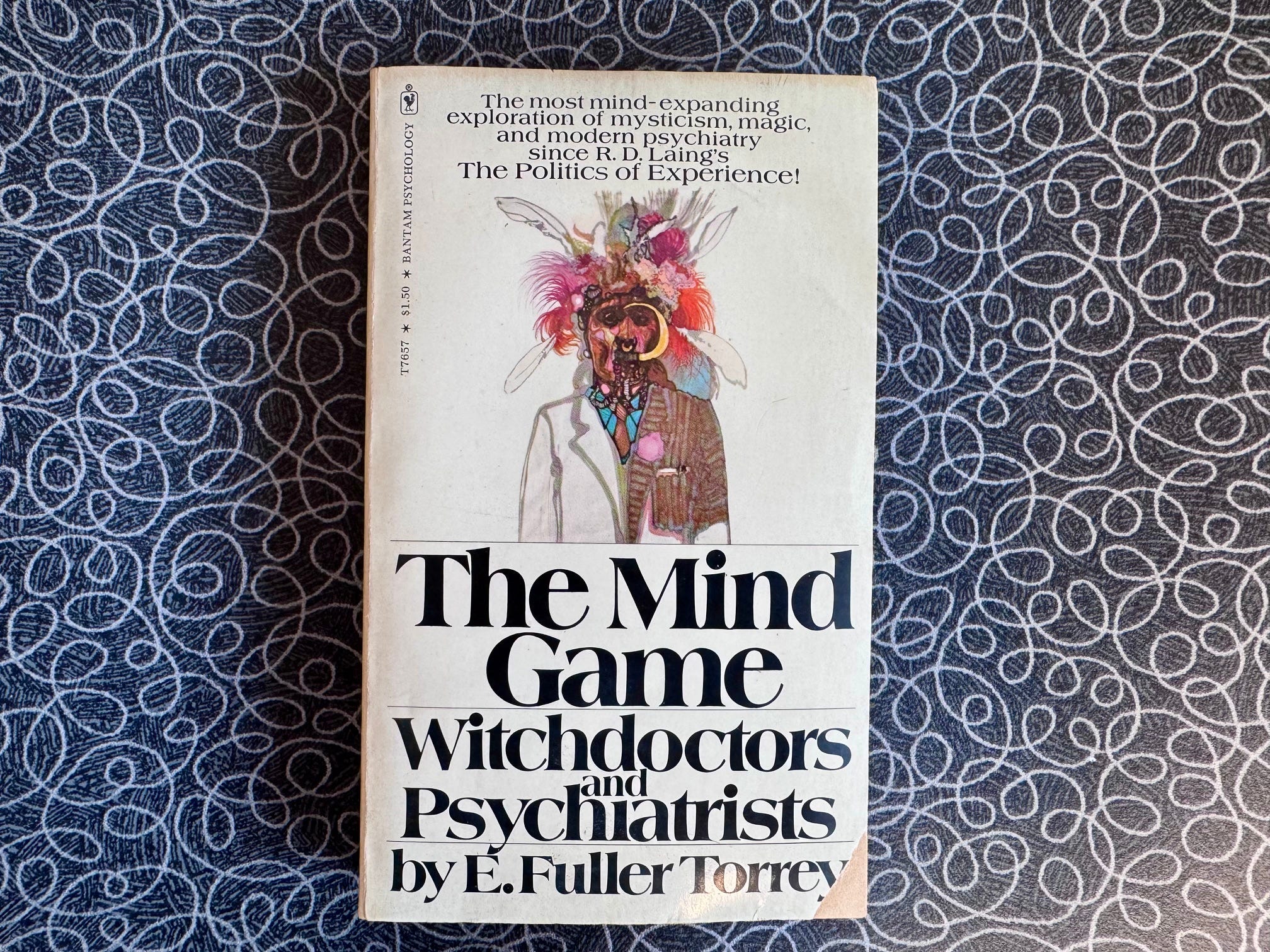
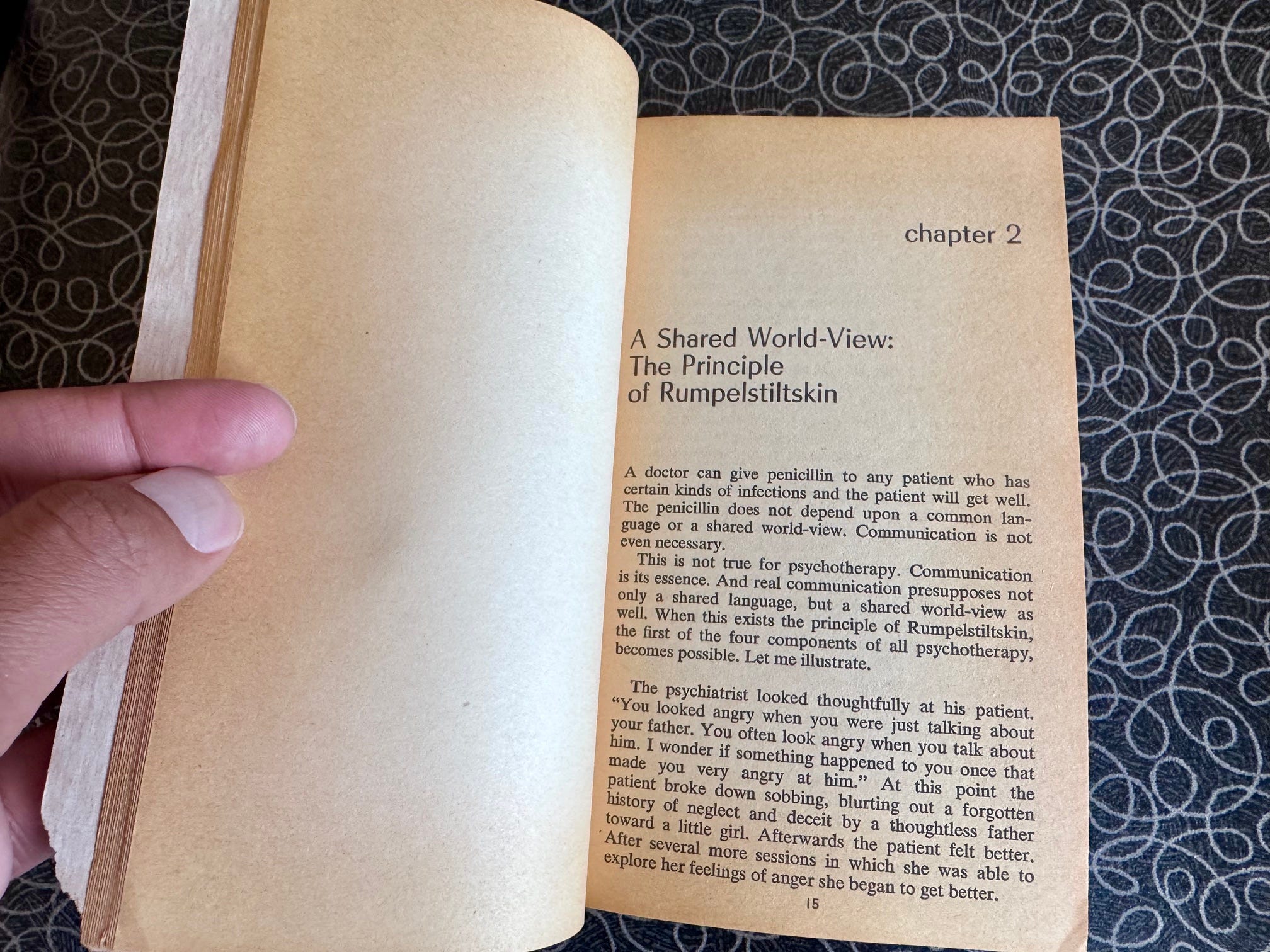
In the paper, we describe the Rumpelstiltskin effect as: “The therapeutic effect of a clinical diagnosis, independent of any other intervention, where clinical diagnosis refers to situating the person’s experiences into a clinical category by a clinician or the patient.”
Torrey lands on the same core idea that naming a problem can itself be therapeutic but he develops this in the context of psychotherapy. Torrey opens Chapter 2 of the book with an excellent example. Penicillin cures an infection without any shared language or worldview between doctor and patient. In fact, the patient doesn’t even need to be aware that they are receiving penicillin for it to work. For psychotherapy as a treatment, however, communication is the substance, and meaningful and effective communication requires a shared language as well as a shared worldview. Where that shared frame exists, the therapist can put a name on what is wrong, and that act of naming acquires power and therapeutic significance.
Torrey gives further examples. A psychiatrist offers an interpretation about buried anger at a father; the patient breaks down sobbing and blurts out a forgotten history of paternal neglect, and improves. A witch doctor reads scattered shells and announces that a family taboo was broken, offending an ancestral bear-protector; the family, relieved to finally know, performs the sacrifices, and the patient improves. These are structurally identical acts for Torrey. The naming reduces anxiety because a trusted authority demonstrates that they understand the problem and they identify an offending agent (whether it is a childhood experience or a violated taboo) and for the afflicted and help-seeking, this can bring about confession, abreaction, and general catharsis.
Torrey and we reach for the same Grimm tale and for the same reason: the queen is saved by getting the name right, and once the name is spoken, the problem dissolves. Both of us treat this as a cross-culturally recurrent structure. Torrey brings up Lévi-Strauss on shamanic healing and we invoke Aarne–Thompson 500, exorcism traditions, and Le Guin.
Torrey cites Lévi-Strauss to the effect that shamans and psychoanalysts alike make unconscious conflicts available through a language in which otherwise inexpressible states can be voiced. The naming process is universal, but its content is culture-bound. A psychiatrist telling an illiterate African his phobia expresses fear of failure, and a witch doctor telling an American tourist his phobia expresses ancestral possession are useless because neither shares the relevant worldview.
Rumpelstiltskin is the first of Torrey’s four universal components of psychotherapy: a) shared worldview enabling naming (the principle of Rumpelstiltskin); b) therapist personal qualities; c) patient expectancy; and d) techniques of therapy. Torrey contends in the book that both psychiatrists and witchdoctors are species of the same genus (psychotherapist). The naming principle is what makes psychiatric diagnosis continuous with divination rather than with penicillin. Its efficacy runs through meaning and shared belief.
“Both therapists are able to name what is wrong with their patients. The very act of naming it has a therapeutic effect… the principle illustrates the magic of the right word.” (p 16)
“Every therapist who has ever had the experience of observing a patient’s relief after solemnly telling him that he was suffering from idiopathic dermatitis or pediculosis knows how important the name is. It says to the patient that someone understands, that he is not alone with his sickness, and implicitly that there is a way to get well.” (p 16)
Torrey’s bio at the start of the book describes him as “a psychiatrist who has slowly come to realize that he is also a witchdoctor.” And the opening lines of the first chapter are memorable:
“Witchdoctors and psychiatrists perform essentially the same function in their respective cultures. They are both therapists; both treat patients using similar techniques; and both get similar results. Recognition of this should not downgrade psychiatrists; rather it should upgrade witchdoctors.”
This is a version of Torrey very different from his contemporary public image, and he is writing from a bygone era of psychoanalytic dominance in psychiatry. The man who wrote that psychiatrists should recognize themselves as witchdoctors later became psychiatry’s most fierce advocate of schizophrenia as a biological disease. There is no self-contradiction here but the shift is significant.
Despite the same core concept, there are some interesting points of divergence in the way Torrey and Levinovitz and I develop the concept. The biggest one is that Torrey is interested primarily in psychotherapy while we are interested in diagnosis and classification. Torrey’s principle is the first of four components of psychotherapy. Our effect is explicitly defined as independent of any other intervention and extends to include considerations around self-diagnosis.
Torrey’s exemplary acts of namings are interpretations, understandably so. Latent anger at the father, violations of ancestral taboo, etc. Our Rumpelstiltskin effect runs in the opposite direction, from the idiographic to the nomothetic, from one person’s particular story to a recognized category with a textbook description and a cohort of fellow sufferers. Torrey is aware that this also works with nomothetic logic, but he walks past it. Torrey gives readers the example of idiopathic dermatitis to show that the phenomenon is present across medicine, and we have a list of similar examples in our paper doing the same.
Our reading of the Grimm tale emphasizes that no ordinary name will do, and a layperson’s description (“funny little man”) doesn’t substitute. That’s what makes “ADHD” different from “I get distracted.” Torrey doesn’t make this explicit because he isn’t primarily interested in the diagnostic label as such, more in the interpretive act.
In terms of mechanisms, Torrey offers anxiety reduction from the realization that “someone understands, that he is not alone with his sickness, and implicitly that there is a way to get well.” We focus on a hermeneutical framing (Fricker), the sick role and ritual/conditioning account (Parsons), affect labeling, and identity/community formation. Our paper devotes a full section to nocebo, looping effects, internalized stigma, foreclosed agency, and the imposition of a deficit narrative on people who understand their experience as gift or transformation. Torrey was writing before the labeling-theory critiques fully matured and long before Hacking.
One thing Torrey emphasizes that I wish we had is the shared worldview as an explicit precondition. We don’t say it that way, but we do nod toward how the effect works within cultural contexts that treat medical diagnoses as authoritative and transformative.
Torrey develops it as a principle of psychotherapy; ours is an effect of diagnosis. Different explananda, arrived at independently, which is what makes the convergence interesting rather than merely awkward. The shift in the framing of this phenomenon, from psychodynamic interpretation to nosological labels, from a universal component of healing to a placebo-like intervention with its own potential harm profile, mirrors broader shifts in the medical and psychiatric culture.
Because we arrive at the concept through different intentions and different goals, I do believe that the way we define and explain the effect retains value. We were right to say in our paper that the Rumpelstiltskin effect as a medical phenomenon is striking and neglected, but we were simply wrong to call it “unchristened.” But with error comes the possibility of correction, and without that error, I might have remained ignorant of this delightful work from 1972 on psychiatrists as witchdoctors.
A note on a common misreading
Since the publication of our 2025 paper, the most common misunderstanding of the Rumpelstiltskin effect I come across is that idea that a diagnosis is overall more beneficial than harmful for the patient. The Rumpelstiltskin effect is not a claim that receiving a diagnosis is a net benefit or a net positive. It is a claim that the mere act of receiving a diagnosis can be beneficial. There is where the analogy with placebo effects is illustrative. The claim in the case of placebo is not that taking a medication is a net positive (that actually depends on a variety of factors). The placebo claim is that even taking an inert medication can be helpful because the act of taking a medication can have beneficial effects. So, one way to think about the Rumpelstiltskin effect is: would a scenario in which a diagnosis is relatively inert (e.g. say descriptive) still produce benefits of the sort seen with etiologically/mechanistically driven diagnoses? We still don’t know empirically what mechanisms best account for the benefit of receiving a diagnosis, or a clinical name, or an interpretation, but we have a variety of hypotheses, and different hypotheses can be investigated using different sorts of controls.

It’s a funny thing because it can be so concretely appreciated in everyday encounters. But the outcomes are highly variable. For example in one instance a female patient will come in reporting that she has bipolar disorder and needs medication in addition to the five she is already taking, to control her anxiety. If I tell her she “does not have bipolar disorder”, perhaps as a predicate to suggest more medication (for example a highly advertised antipsychotic or more alprazolam), is likely to do more harm than good, she might become outraged that I disagreed with her self-knowledge.
In another (just as likely) scenario, a woman of color might come to me complaining that her previous prescriber, a (male) nurse practitioner prescribed her multiple antipsychotics and mood stabilizers for “bipolar disorder” the np was sure she had due to her insomnia and sexual promiscuity (two-timing her boyfriend). I tell her she does not have bipolar disorder and she is relieved. I also tell her that her behavior is not what clinicians typically call “sexual promiscuity”.
I just want to add the first instance is a sort of imagined amalgam of multiple encounters, don't take my part too seriously (for example diagnosis relating to choice of sixth medication). The second instance is an actual case. A nice demonstration of why the DSM "method" is so flawed due to few symptoms' being unique to any diagnosis.
We humans get anxious about things we don’t have an explanation for. It’s more important to have one than to be sure it’s “correct,” regardless of how we determine correctness.
What goes for “diagnosis “ has long been applied to delusional ideas; they do explain and thereby reduce anxiety. Wish I could recall who first talked about that, but it’s been decades.