


“A man will be imprisoned in a room with a door that’s unlocked and opens inwards; as long as it does not occur to him to pull rather than push.”
Ludwig Wittgenstein, Culture and Value
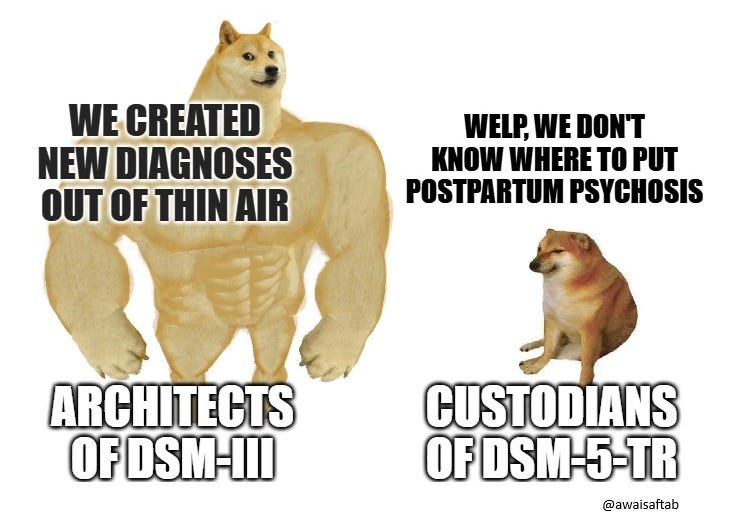
When it comes to the DSM, the vibes are Kafkaesque through and through. It is common for the manual to be portrayed as based on expert consensus, oriented towards the pragmatic needs of psychiatric practice and research, and for its diagnostic categories to be “invalid” in the sense that they don’t represent discrete disease entities or map onto a coherent neurobiology. One would imagine that a manual like that would be attuned to the clinical needs of mental health professionals, that it would be flexible and able to incorporate diagnostic categories based on expert agreement and public significance… but, nope. To gaze into the machinery of the DSM is to gaze into a convoluted bureaucratic contraption that is fueled by an odd mix of tradition and conviction, and that is beholden to a peculiar set of processes and priorities, and that has a pompous self-image that is entirely at odds with its reputation.
The mental health professions are so fractured and divisive that only a manual as deeply flawed and as deeply disliked as the DSM could acquire some sort of symbolic authority. The DSM is an official classification of mental disorders, but it neither reflects new scientific developments nor established clinical wisdom. It is not a compendium of all clinically relevant psychopathological presentations; there are gaps in the current schema. The categories are neither arbitrary nor valid, but something in between… they have the status of being supported by validators to some degree, but without any assurance that this is the optimal configuration for the validators. The manual is continuously revised, but the burden of evidence demanded since the 1990s to make changes to its historically contingent architecture is so onerous and proposed changes are so vulnerable to being vetoed by APA insiders that it is like trying to get blood out of a stone. And when the manual does manage to get new categories incorporated officially, the result can seem mangled. E.g. the only new category to be added to the DSM since 2013 is “prolonged grief disorder,” and it took a huge amount of effort on the part of everyone, backed by a substantial amount of empirical evidence, to get it into the DSM, but arguably, “prolonged grief” is the wrong clinical characterization (the problem is not primarily that grief is prolonged) and the duration threshold of 1 year makes little clinical or scientific sense and was seemingly chosen as an overly conservative cut-off out of fear of public backlash against over-medicalization.
Unsurprisingly, the manual is slowly bleeding relevance and authority. Psychiatric research has increasingly become transdiagnostic. Elements essential to a good psychological case formulation are not covered by the DSM so clinicians look elsewhere. FDA doesn’t require that DSM categories be used as indications for drug development. Clinical communities have created their own specialized alternatives better suited to their needs (e.g. the Hierarchical Taxonomy of Psychopathology and the Psychodynamic Diagnostic Manual). And while many rely on it as a billing manual, you don’t even technically need it for billing, as you can bypass DSM and directly use the International Classification of Diseases (ICD) by WHO.
I say all this as background because it is crucial to understand why the DSM is struggling to incorporate “postpartum psychosis” as a diagnostic category. There are too many stakeholders, too many competing interests, and not enough clarity on what is really important to the DSM. There is an excellent article in the New York Times by Ellen Barry and Pam Belluck (Jan. 20, 2026; gift link) on the debate around including postpartum psychosis in the DSM, presenting the perspective of both the researchers behind the proposal and of DSM insiders.
The proposal for inclusion of postpartum psychosis in the DSM is described in detail in this paper (Veerle Bergink, et al.) in Biological Psychiatry by a team of prominent reproductive psychiatry experts. Postpartum psychosis is a clinically recognizable and clinically well-described psychiatric phenotype with its own distinct characteristics. While pregnancy is not associated with an increase in risk of mania or psychosis, the early postpartum period is well-recognized, both clinically and epidemiologically, as a time period of elevated risk (according to the article, there is a 10-fold increased risk of developing first-onset psychosis or mania). There are distinct biological factors involved in the postpartum, with endocrine, immune, and other physiological changes, all of which seem relevant to the increased risk. There are treatment algorithms specific to postpartum psychosis. Postpartum psychosis is a period of high risk in the form of both suicide and infanticide risk. Short-term and long-term course trajectories are distinctive.
At present, DSM doesn’t have separate categories for postpartum psychosis or postpartum depression. DSM instead has “peripartum” specifiers, referring to the time period during pregnancy and 4 weeks postpartum, for depression, bipolar disorder, and brief psychosis. The fragmented nature of postpartum psychosis in the DSM and the inclusion within the peripartum period mean that postpartum psychosis doesn’t exist as a distinct formal diagnosis in the manual.
The proposal recommends placing postpartum psychosis as a distinct category within the bipolar disorders chapter of the DSM. Within the current organization of the DSM, especially if the choice is between placing it in the schizophrenia spectrum chapter and the bipolar disorder chapter, the experts behind the proposal favor the bipolar disorder because...
1) most women with PP have prominent affective symptoms; 2) treatment response to lithium and electroconvulsive therapy is excellent; 3) in half of the cases, first-onset PP is also the first onset of bipolar disorder; 4) pregnant women with bipolar disorder are at very high risk of PP; and 5) the genetic risk architecture for PP is distinct but overlapping with bipolar disorder.1
Here are the proposed criteria:
the onset of at least one of the following states (at least 1 of 6) within 12 weeks of childbirth, lasting at least 1 week and present most of the day, nearly every day, or for any duration if hospitalization is necessary: 1) mania/mixed state; 2) delusions; 3) hallucinations; 4) disorganized speech or formal thought disorder; 5) disorganized, confusional, or catatonic behavior; or 6) depression with psychotic features.
Experts believe that doing so will facilitate diagnostic recognition, better training, more research attention, better preventive efforts, improved forensic expert opinion, and improved awareness that postpartum psychosis has a strong link to bipolar disorder than to schizophrenia spectrum disorders.
From the DSM perspective, the biggest obstacle is the placement. While postpartum psychosis does indeed have a strong relationship to bipolar disorder, the syndrome remains diagnostically heterogeneous. Around 30% of women with postpartum psychosis don’t meet criteria for bipolar disorder and those presentations are more consistent with psychotic depression or primary psychosis.
Let’s take a look at some of the discussion presented in the NYT article. Emphasis added via bold text is mine.
“Criteria added to the D.S.M. in 2013 allow doctors to diagnose bipolar disorder, psychosis or major depression “with peripartum onset.” This solution captures the disorder’s heterogeneity but doesn’t draw the same kind of clinical attention that a stand-alone diagnostic listing would, some mental health experts said.
“Dr. Bergink stressed the human cost of delaying the move — women who are misdiagnosed, or sent home with reassurances about the “baby blues.” She recalled some of the most tragic outcomes…
“[Members of the Serious Mental Disorders Committee were] split on whether creating a separate diagnostic category was the best way to ensure it. A slim majority favored that option, but a substantial minority voted to remain with the current formulation, in which major disorders can be diagnosed “with peripartum onset.”
“There was not a clear consensus,” [Dr. Carrie Bearden] said, and the narrow margin felt insufficient for a change of this consequence. One reason for this, she said, is a sense that the D.S.M.’s decisions cast such a long shadow over psychiatric practice.
“It’s science, but it’s also a group consensus,” Dr. Bearden said. “It also has a major influence on treatment and on policy. So we can’t just go with, well, this is the best evidence that we have at the moment, so let’s take a very decisive action.”
Experts in maternal mental health said the D.S.M. would have to balance the benefit of raising awareness against the risk of codifying a disorder that is not fully understood.
“Dr. Margaret Spinelli, a specialist in postpartum psychosis at Columbia University, said she worried that placing the condition in the bipolar category would cause emergency room doctors to miss it if “it’s not right there under psychosis.”
But Dr. Spinelli… said the benefit of greater prominence in the D.S.M. outweighed those concerns.”
“Ms. Lodha said she doesn’t care where it appears in the D.S.M., as long as it appears.
“To me, it’s less about the categories, and more about how do we actually legitimize, prioritize, normalize this illness by having it in the D.S.M.,” said Ms. Lodha, who is now on the board of directors of the nonprofit Postpartum Support International.”
Reading this, do you get the sense that there is clarity on what the DSM is really about, what the overarching priorities are, what is considered sufficient evidence for inclusion, and what sort of considerations are legitimate reasons to override available evidence? I know I don’t. For example, there is this general sense that people rely on the DSM for training and treatment decisions and policy decisions, so proponents of postpartum psychosis think that including this condition as a distinct diagnosis is really important, while opponents of the proposal appeal to the same considerations (people rely on the DSM for training and treatment decisions and policy decisions…) so we shouldn’t take any decisive action because we are worried about possible repercussions.
The way I see it, there are 3 separate questions:
Should postpartum psychosis be recognized as a distinct condition, and do we have sufficient evidence, including validator evidence, to support that recognition?
If the answer to 1 is yes, where should postpartum psychosis be placed within the structure of the manual?
What are some downstream consequences (clinical, research, training, advocacy, etc.) of a) recognizing postpartum psychosis as a distinct entity and b) putting it in the bipolar disorder chapter, and should these downstream consequences override inclusion if the evidence is otherwise adequate, or should these downstream consequences be considered sufficient for inclusion if the evidence is not otherwise compelling?
If the answer to 1) is yes, then uncertainty about 2) is a mere detail. An important detail, no doubt, but something to figure out rather than reject the proposal. And if the evidence for 1) isn’t sufficient, then 2) is moot anyway.
If placement in the bipolar disorder chapter isn’t perfect, there is nothing really that stops the DSM from having a separate chapter for postpartum disorders. The only thing stopping the DSM is a bunch of self-imposed rules and conventions.

The DSM chapters are generally organized by symptom patterns, but we already have exceptions. Trauma and stressor-related disorders. Substance-induced disorders. The neurodevelopmental disorders chapter is focused on a developmental period. So a postpartum chapter isn’t disallowed by the internal logic of the manual. In fact, ICD-11 already has a “Mental or behavioural disorders associated with pregnancy, childbirth or the puerperium” section.
What prevents the DSM, I suppose, is a post-DSM-5 loose commitment to a meta-structure based on validator evidence. This commitment is not strictly applied anyway, but a separate postpartum chapter likely draws further attention to meta-structure as a practical construct. Second, the DSM revision committee is supposed to evaluate specific proposals, and the specific proposal here is for placing postpartum psychosis in the bipolar disorder chapter. The bar for restructuring the DSM is understandably high and I suppose it’s unclear what sort of evidence would be sufficient. The DSM editors probably realize at some level that chapter organization can be read naively as claims about psychiatric kinds, and they don’t want to make a kind-claim about postpartum disorders. But again, this leaves everyone unclear about how the manual handles ontological versus practical considerations.
I don’t believe I have seen any clear articulation from the DSM leadership on where it stands on question 3. A diagnostic manual should have clarity on what is its central purpose. Is the purpose of the DSM to present a comprehensive classification of psychopathology? Is the purpose of the DSM to classify those psychopathological states that are supported by a particular threshold of validator evidence? Is the purpose of the DSM to classify clinical problems that deserve recognition and awareness? Is the purpose of the DSM to decide on inclusion based on balancing “the benefit of raising awareness against the risk of codifying a disorder that is not fully understood”? Does the DSM prioritize facilitating clinical recognition or a perfect fit into its existing schema? There are no principled, universally applied answers to any of these. This is what frustrates people about the DSM, why they call the process “political” in a pejorative sense. There is no consistency, no respect for evidence, no clear bar for when downstream implications matter and when they don’t.
And resultantly, I do not believe that DSM deserves the respect and authority we bestow on it. Whether postpartum psychosis receives adequate clinical recognition and whether it is prioritized in terms of advocacy and research does not and should not depend on the DSM. If the DSM can’t be a part of the efforts—whether by principle or by the whims of its editors—to recognize the existence of postpartum psychosis as a serious condition deserving a serious response, then it is the DSM’s loss, another step in the steady deterioration of its relevance. Either the DSM is concerned only with the degree of scientific evidence and not with the “human cost,” in which case we are asking it to do something it is not designed to do, or the DSM is a document that is responsive to clinical and practical needs, in which case it is failing to fulfill its mission.
See also


The authors add, “A footnote could be placed in the psychosis chapter so that clinicians will be redirected to the bipolar chapter.”
One example (or perhaps counter example to your argument) is Premenstrual Dysphoric Disorder (PMDD). Its inclusion in DSM-5 and ICD-11 has given the diagnosis more credibility among researchers and clinicians. It may be coincidental, and is based purely on vibes, but I feel the inclusion gives impetus to improving clinical care for women with this disorder. It has also helped draw attention from media, the public and hopefully research funders.
"The way I see it, there are 3 separate questions:..."
One thing I always appreciate about your pieces, Awais, is the format. It makes it much easier for me to locate where, within the arguments you're engaging, my own disagreements actually sit (although in this piece I have none).